
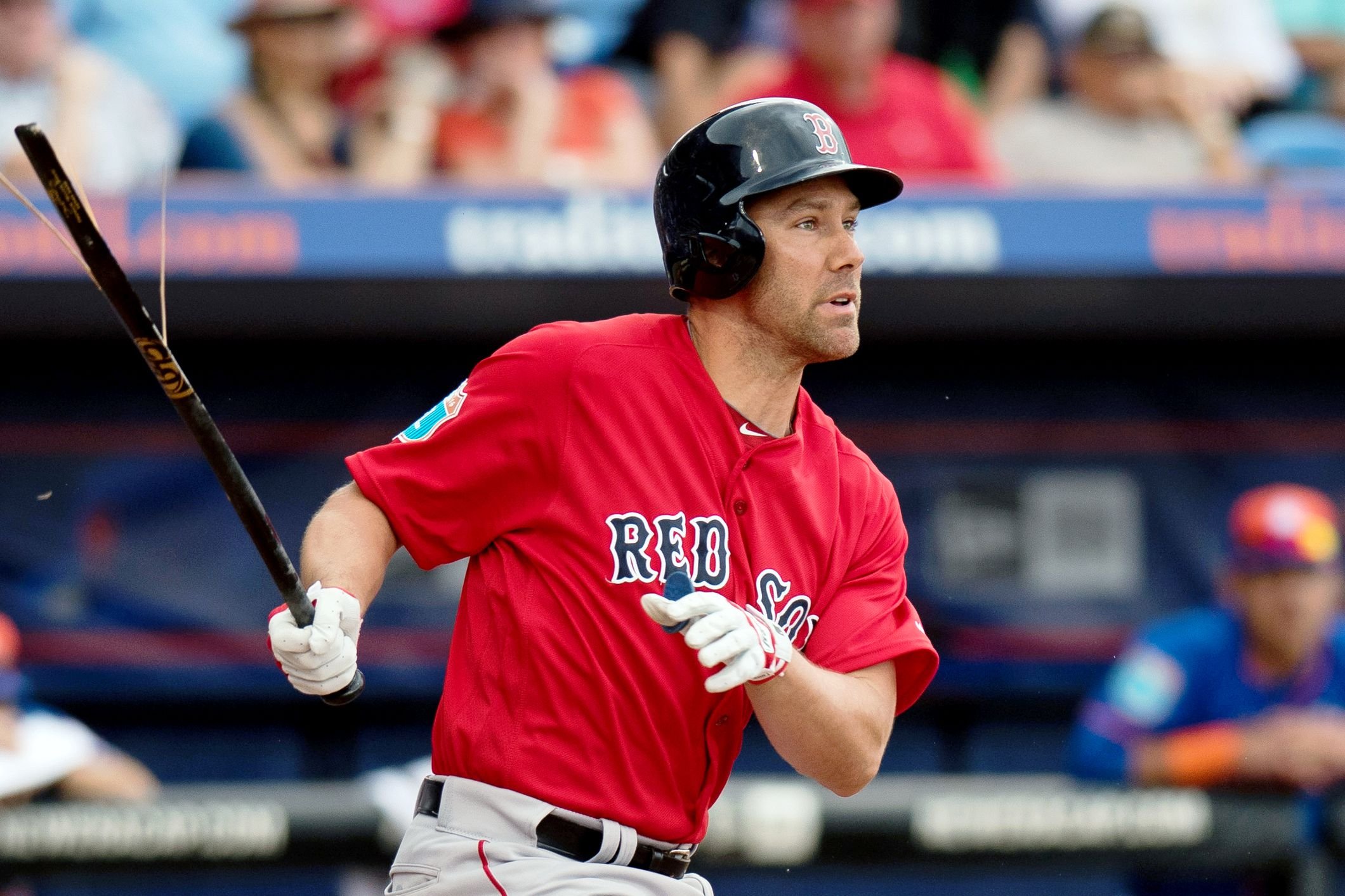
Robby Incmikoski: Murphy, I want to talk to you mainly about Fenway Park. You made your major league debut at Fenway Park as a member of the Boston Red Sox. You were drafted 17th overall—I don't know what the prospect hype was for you as a first-round pick, and you were a college pick so you get to the big leagues a bit quicker than high school picks. What was your first reaction when you got drafted by the Boston Red Sox, knowing that someday you were going to play big league games at a historic ballpark like Fenway?
David Murphy: I don't think I realized how historic Fenway was until I got drafted by the Red Sox. I don't think I even realized how big the Red Sox-Yankees rivalry was. Growing up in Texas—and it's not like Texas isn't a baseball state, but it's predominantly a football state. You've witnessed it now, Robby—Texas has good fans, but fans in the Northeast, especially Red Sox and Yankees fans, are intense when it comes to baseball.
I thought I knew about the Red Sox franchise, but I don't think I knew a lot about the history until I was drafted. It didn't take long—even my first week in short-season ball, I had fans comparing me to Ted Williams! Come on, let's pump the brakes there.
An introduction to that culture came from playing in Cape Cod League the two summers between my college years. Early in the season, we would go read books to kids in elementary schools for community engagement. We'd ask them random questions like "How many years has it been since the Red Sox won a World Championship?" and all these kids would know the answer. They knew all this Red Sox trivia. That gave me insight into what I was getting into with the fan base—how not only do grown men know their baseball, but they've passed it on to their families and kids.
Robby: What do you remember about your major league debut? Tell me about the moment when you got the call, the physical surroundings, where you were, and what it was like knowing your big league debut would come at Fenway.
David: When I got the phone call, I was having a pretty good season. I started the year in Double-A as a repeat year, then went up to Triple-A in late May and continued to have a good season. So I was kind of expecting the call, knowing that rosters were expanding in September and that the Red Sox had an okay year but probably weren't going to make the playoffs. That would give me some opportunity, even though with the veteran outfield, I knew I wasn't going to get a lot of playing time.
It was August 31st, and I'm waiting around in the clubhouse expecting some communication. I waited long enough without hearing anything, so I told my wife, "Let's get in the car." We're probably 10 minutes down the highway heading back to our apartment when I finally got the phone call from my manager, Ron Johnson. He said, "Congrats, you're going to the big leagues. Come get your stuff because you're going to Boston tomorrow."
So September 1st, we make the 45-minute drive from Pawtucket to Boston. They were in the middle of a homestand. I walked into Terry Francona's office. I was overdressed—I didn't know the etiquette at home. I knew on the road you had to dress up a bit, but I went in full slacks and a nice white button-down shirt. I was the first guy there, showed up really early at one o'clock.
One of the first things Tito said was, "You don't have to dress like that—you can wear a t-shirt and shorts at home if you want." He asked if my family was coming to town. My parents and in-laws came in, with more family coming the following days. He said, "I'll sit you tonight and give you an opportunity to start tomorrow, and we'll see where playing time goes from there."
It wasn't my first time at Fenway, but walking in there—Fenway's got a one-of-a-kind smell that I can't put into words. It's not the best smell, but because it brings back good memories, it is a good smell. It's kind of like this old, musty ballpark. You walk through and immediately have this feeling of the history of the franchise and those who have played before you.
After I signed after the draft, they flew me up there. That was the first time I got to go inside the Green Monster. We got to sign the wall with hundreds of autographs from players who had gone before me. So that was a really surreal moment.
Getting to start my first game on September 2nd, I singled in my first at-bat. The team didn't play very well—AJ Burnett threw a great game against us. It was a dreary, gloomy, overcast day, and we didn't win, but obviously getting your first hit and feeling like you contributed in a major league game for the very first time makes you feel like you've arrived. If I got hurt or something happened and I never played in another big league game, I had contributed on some level.
Robby: Do you have the baseball from your first hit?
David: I do. I'd have to find it, but yes, I do have it.
Robby: Tell me about your first major league home run.
David: My first major league home run was in the old Yankee Stadium. Going into that series, we were going to have a day-night doubleheader on Saturday and then the ESPN Sunday night game. We got rained out Friday night, so we had back-to-back day-night doubleheaders. On a team that wasn't necessarily contending, they let the young guys play in the doubleheaders.
I started the first game on Saturday and had an okay game, earning more playing time. Randy Johnson started the night game, so I definitely wasn't playing in that one as a left-handed hitter. I knew I was playing Sunday morning, but when I looked at the lineup, I saw I was leading off—my first appearance in the leadoff spot. Jaret Wright was on the mound—he's most famous for starting Game 7 for the Cleveland Indians in the '97 World Series.
He got me to two strikes and threw a fastball in. I took advantage of the short porch in right field and hit it a few rows deep. It got in on me slightly and jammed me a bit, but I knew what I was dealing with in that short porch, so I felt like I got it. Sure enough, I round the bases after my first big league home run as a member of the Red Sox in old Yankee Stadium. I immediately knew how cool that moment was.
From there I kind of blacked out. I stepped on home plate, going back to the dugout, and David Ortiz was in the on-deck circle. His arms were wide open, and I completely ran past him! I saw him at the last second with his arms open wide, and I think I reached back and gave him an awkward five as I passed him. It's something we laughed about later.
I thought it was the coolest thing in the world that I was batting leadoff in a big league lineup and happened to lead off the game with a homer. And doing it as a member of the Red Sox against the Yankees—the fans had no problem throwing that baseball back, so I have that one also.
Robby: What would you say to a fan who wants to go to Fenway but hasn't yet had the opportunity?
David: It's just a really neat, intimate baseball atmosphere. If you're a big enough baseball fan and have felt the energy throughout certain ballparks, Fenway is as good as or the best in baseball. The fans always know what's going on. They're not fair-weather fans—when the team is playing well, they track the team and are super into it. When the team isn't very good, they still stay in tune with everything. The team is always part of the buzz of the city.
It's an old-school ballpark. Especially for me being 6'3", you're not going to have a ton of leg room—your knees are going to be bumping the seat in front of you. But that's part of that old-school feel and stepping foot in a ballpark that's over a hundred years old, that opened the week that the Titanic sailed.
I remember going back to my Cape Cod days, walking through one of those tunnels and seeing the Green Monster in person for the first time, realizing what a cool thing that was and how special it was in the grand scheme of baseball. There are so many things you see on TV that are neat and want to see in person someday.
When you walk through the tunnel and have that wide-open view of the ballpark and left field, it's just one of those great baseball moments. The corridors and everything are so tight because the ballpark is from a different era of construction. You're trying to squeeze in as many seats as possible in as little space as possible. So it's not the most comfortable place, but when you're a true baseball fan, it's as good a treat to witness a game and walk through that ballpark as any out there.
Robby: You were a starting outfielder on back-to-back American League championship teams, and you were one strike away from winning a World Series. That's hard to do—not only are there millions of young baseball players who aspire to do that, but there are probably hundreds of major leaguers who wish they had the chance to play in a World Series, and you played in two in a row. What was that experience like, and now that your playing career has come to a close, what memories come back when you think, "I was one strike away from winning a World Series"?
David: My rookie year was 2008, my first full year. Coming from the Red Sox, who were such a good team, to the Rangers (the trade happened in 2007 when the Rangers weren't very good), we slowly but surely started to rise and become a contending team. At first, when I was traded over, I thought, "I don't necessarily care about how good the team is right now because I'm just trying to make it as a big leaguer, trying to establish myself." After I accomplished that, then I wanted to play for a winner.
It was cool to see how the team progressed. In 2010, coming off a pretty good season in 2009, we acquired Vladimir Guerrero in the offseason, had a good start to the season, and got Cliff Lee at the trade deadline. We thought we were legitimate contenders, but we knew the Rays, Yankees, and other teams with postseason experience stood in the way. You don't know what to expect when you're an inexperienced postseason team.
The series against Tampa was great. They had been to the World Series two years before and lost to the Phillies. That was a big confidence booster, and throughout that series, we realized we were a really good team with superstars who don't back down and thrive in pressure-packed situations.
We got the opportunity to play the Yankees.
David Murphy (continued): We got the opportunity to play the Yankees. Sabathia started for them in Game 1. We had a big lead, and then it's like you question yourself for a second because the mystique of the pinstripes took over around the fifth, sixth, or seventh inning. We lost the lead, and the Yankees ended up coming back and winning. I thought, "Is that how the series is going to go?" But there was still confidence going into Game 2. We breezed through Games 2, 3, and 4, lost Game 5, then came back home and won Game 6 to go to the World Series.
What a cool moment celebrating at home with all my teammates on the field—what an achievement to get to the World Series! It didn't go how we wanted. The Giants were great with Lincecum and Cain. On paper, our offense was better, but their offense ground out at-bats and got big hits when needed. Tim Lincecum was phenomenal—okay in Game 1, but nasty in Game 5. That was Bumgarner's coming-out party too.
As frustrating as it was, we were still thinking, "All right, we've got the majority of our group together. We'll just do it again next year." We pretty much breezed through the season and celebrated again at home after winning Game 6 to go to the World Series in 2011. It was almost too easy—another year came and went, and we're going back. That's how good a team we were.
Once again, I believe we were favored. We lose Game 1, win Game 2, Cardinals win Game 3, we win 4 and 5. Everybody remembers Game 6 and how heart-wrenching it was—we were one strike away twice. David Freese got a big hit and then Lance Berkman got a big hit, both heartbreaking. But Josh Hamilton hit a big homer to give us the lead somewhere between those two hits. So there was still confidence even though these guys were battling. We were a talented, really good team that had answered the call in every situation.
Even when David Freese hit the walk-off homer in Game 6, I still felt positive going into Game 7. We take the lead early on, but David Freese hits a big double, they continue to add on, and it's 6-2 in the later innings with our backs against the wall. I give a lot of credit to that Cardinals team—whatever we threw at them, they were able to rally back and overcome. That's what postseason baseball is—you have to have a short memory, not let little things get you down, and just continue to play consistent, good baseball.
I mean, Ken Griffey Jr. was my favorite player of all time, and he never played in a World Series. I got to play in two. Beyond that, there are players who get to play in World Series who don't have a chance to win, and maybe that makes it more heartbreaking that we were one strike away two different times and didn't close out the deal. A lot can be learned from it—that's kind of the game of life. How often are we close to things we want that we don't achieve? I give all the credit in the world to the Cardinals. You try to find the silver lining, but when I see highlights, it makes me a little sick to my stomach. That's the natural part of being a competitor.
I think when Nelson Cruz struck out in 2010 to end it, I was coming up two hitters later. So I'd be lying if I didn't kind of calculate that there was a chance I might be the last guy. You go up and battle and try to have a great at-bat, extend the game, do whatever you can. But with the way the Cardinals were fighting back all series and being down 6-2 at that moment, it felt like we were down by 10.
I did not enjoy running close around their dog pile. A lot of guys will stand on the top rail of the dugout to watch the celebration, probably because they want to remember what that felt like so when they get the chance the following season, that's their motivation. I can't remember exactly, but I think I went inside—I wanted nothing to do with that. There was a little disgust that I didn't get the job done, even though my hit would have just continued the inning without an impact on the game. Just that feeling in your stomach, knowing how close we were and that we didn't get it done, and I was the last guy while they're celebrating.
I still have the helmet I was wearing when that happened. They were going to auction it off, and I asked if I could keep it. So I still have it.
I had three kids at the time, but one wasn't even a year old, so he didn't make the trip. Both my daughters, my two oldest, were there. I think they had the families in the hallways to bring them on the field in anticipation that we were going to close the deal and win the World Series.
One of my daughter's favorite parts of that season was when we won the ALCS against the Tigers. Families got to come on the field, and because of Josh Hamilton's history with alcohol, we made a separate celebration where we poured ginger ale on each other. I gave my daughter a bottle of ginger ale to be part of the celebration, and she dumped it on my head—she loved it. I think I have the video from MLB Network's Quick Pitch of her doing it. So when the World Series didn't happen, my wife tells the story that my daughter was in tears because she wasn't able to come out on the field since we weren't going to win the World Series.
It's amazing—baseball is such a game that incorporates not only the player but the families as well. That was one memory that crossed my mind as I was walking through the guts of the stadium underneath, thinking about what my family was going through in the timeline of what was happening on the field.
Robby: What was your favorite thing about your home ballparks?
David: In Texas, it was the architecture of the ballpark and the jet stream to right-center. Once I got to the big leagues, I finally figured out how to pull the ball. I was never a big power guy in the minor leagues, but that wind really carried the ball to right-center. So once I figured out how to turn around a fastball, not only did I love playing at home and love the way the ballpark looked, but the way it played catered perfectly to my swing and my game.
When I went to Cleveland, I hated the cold weather early on as a Texas kid—that was my least favorite thing for sure. But I had good memories of that ballpark from when I was a kid and those Indians powerhouse teams. I loved the backdrop of that big center field batter's eye. I loved that it had that Fenway-like big left field wall with seating above it, which Fenway back in the day didn't have. There was a comfort to it that was neat.
Cleveland never drew a ton of fans when I was there, but the fans who showed up knew their baseball. They would encourage you but weren't afraid to get on you and push you. I think that was just the general feel of the city and the blue-collar nature. I loved the grit and grind and feel of that city that carried over into the teams and ballpark.
In Anaheim, I only played there for two months, but what I loved as a visiting player too was that it was my favorite surface in baseball. It felt like you were walking on a fairway when you're on the infield and outfield. Every time on the first day of every series there, it made me happy just being there—the feel of the grass and the way the ball would skid or roll through it.