
Alan McDaniel (Transcript)
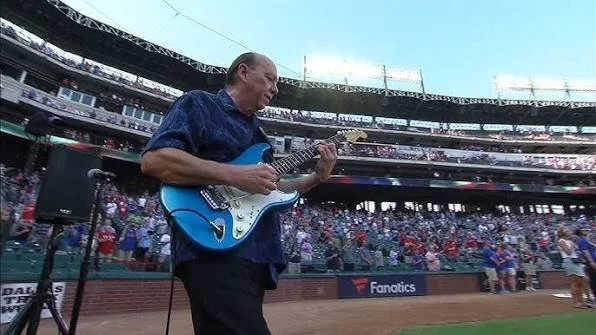
Robby Incmikoski: So we've got Alan McDaniel. Tell me your background—are you from Texas? And if not, how did you end up in Texas?
Alan McDaniel: I was born in Dallas, so I'm indigenous to the region. Went to high school here in Dallas, Bryan Adams, stuff like that. Grew up with the Cowboys, and then the Mavericks came along, then the Rangers came along. Just lived here in Dallas all the time. Been a musician since probably elementary school.
Robby: How long have you been a television technician? And how did you get into that business?
Alan: I've been in about 22 years. It was just kind of another happenstance thing. A friend of mine that I went to school with was a cameraman—he passed away with cancer years ago—but he brought Toast, which you've met. He brought Toast to one of my open jams where people could come and play. Toast watched me pack up my gear and asked, "How long you been doing your stuff like this?" Which is just kind of the same way they do it at the truck. He said, "I've got a job for you, because you know what you're doing there."
So I went in and started shadowing, and before I knew it, I was on the visitor show and then made it to the home show, which is what everybody wants to do—be the home show guy. I've just been doing audio ever since with the three sports: the Stars, the Mavs, and the Rangers, occasional other things.
Robby: How much of a baseball fan are you? Casual, die-hard, avid, anywhere in between? How would you describe your fandom for the game?
Alan: When you're around it for 22 years, you kind of get enough, but at the same time, I enjoy the spectacle of it. I started out playing Little League baseball when I was eight years old. The problem is my dad was the coach, so every afternoon it was, "Hey, let's go throw the ball around," when I wanted to go ride bikes and play with my friends. So I kind of burned out at an early age on playing.
But we used to go to Turnpike Stadium, which was the Rangers' first home, and I watched games there. I can remember another place called Burnett Field, which is way back—I was probably about seven, eight years old, just barely remember that. I've always liked baseball, but I was a three-sport guy, and baseball wasn't it. I played basketball, football, and track because I wasn't any good at baseball.
Robby: Your seventh-inning stretch is at the new ballpark, not the old one, correct?
Alan: Right, it just started this year.
Robby: How do you go from audio technician to electric guitarist whose version of the seventh-inning stretch plays every game at the home of the World Series champions?
Alan: It's just amazing. Back at the old ballpark, one of our camera guys started jawing with the grounds crew, and it became a challenge to play them in a softball game. So he went out to Mansfield to a place called Field of Dreams, and they basically handed our butts to us every time because they were good—average age was in their upper 20s and our average age is mid-50s.
At that game, I said, "Hey, I can play the national anthem." So I did at that softball game. Word got out—Toast and Malcolm both went to Chuck Morgan and said, "Alan needs to do the national anthem." So in either 2018 or 2019, I did the national anthem at the old ballpark.
That got me in with Chuck Morgan. I went up to audition, but he said, "No, you don't need to audition. You're good enough." What I remember about that game is they announced that Elvis Andrus and Asdrubal Cabrera had just gotten their American citizenship. So I felt like they were hearing the national anthem as American citizens for the first time when I was playing it.
I later got to do it at the American Airlines Center for a Mavericks game. Then when they went to the bubble in Orlando in 2020, Toast made a video of me doing the national anthem, they sent it to Orlando, and Chuck Morgan played my national anthem to an empty stadium with all the cardboard cutouts about four or five times. He did it for his 3,000th consecutive broadcast and said, "Alan, I can't think of anybody's national anthem I'd rather hear than yours." So I felt very special at that point.
Then last year, just before the season, Chuck Morgan contacted me. He had heard guitar versions on a Mets game and a Padres game, and he said, "I want electric guitar. Can you give me the style of ZZ Top? Make it real Texas." So I did all that—I gave him Stevie Ray Vaughan style, ZZ Top style, and I even got my old steel guitar out to really country it up and make it Texas. They used that last year and they went all the way to the World Series—first year of my guitar!
This year, Chuck handed over the Rangers entertainment to another guy, Chris DeRusha, and he contacted me and said, "Hey, how would you like to do 'Take Me Out to the Ball Game?'" I turned it around and he said, "I know we have a game tomorrow, so it's a little short notice, but can you have it for Opening Day?" I had it the next day for him, and they just fell in love with it. So the 30-year tradition of the organ "Take Me Out to the Ball Game" got replaced this year with my electric guitar.
Robby: How cool is that? What's your reaction every time the seventh-inning stretch happens and you hear it? What goes through your mind?
Alan: It's really surreal to me at times because I've been working out there forever. The hair stands up on my arms. I see people singing along with it, and if I'm not on duty, I'll go out into the bowl so I can listen to it happening and hear the people singing. It's just an amazing honor. I've been a musician since seven or eight years old, and I never thought that one of the biggest feathers in my cap was going to be something with music and sports. That wasn't something I had aimed at, but Chuck Morgan made it a reality.
Robby: What do your co-workers say to you about it?
Alan: They think it's pretty cool. They've always been fans of my playing. At the old ballpark, we were outside, and before the game, a couple of us would be playing guitars just for a jam session. Around the league, some of the teams that would come in would say, "Hey, where's the jam session?" if we were playing.
I found out there's a faction of musicians that work in TV, retired musicians, and we all get together and jam. We've actually done about seven or eight videos that are on YouTube. The band's called the Dirty Merkins—nothing dirty about the channel or the band, just the name. You can go on YouTube to the Dirty Merkins Channel and see our videos. Toast is our video producer, and he also put my national anthems on there. I have a lot of fans just at work. Even before I got involved with the Rangers musically, they were already fans, so they were proud of me and happy for me.
Kyle Fager: Can you talk me through what your role looks like at the ballpark? How do you do your job?
Alan: My official title is the A2. The A1 is the guy that's on the actual mixing board and mixes all the mics. The A2—there's two of us on the show—we set up all the mics. Malcolm and I do the field effects. I'm responsible for the pre- and post-game set, and I'm also responsible for shadowing Emily Jones or whoever the on-field reporter is.
That has allowed me to actually sit and play my guitar through a couple of innings over the years and do a little woodshedding, which helped my abilities and gave me exposure to the guys around the league.
Robby: What guitar is it played on? What guitar do you use?
Alan: I'm sure you've heard of a Stratocaster? A Fender Stratocaster—that's what Stevie Ray Vaughan, Jimmy Hendrix, Eric Clapton, all those guys play. For my national anthem, I do a trick using echo and a volume pedal, so it doesn't really sound like a guitar as much as it might sound like a cello or an organ.
I had a couple of security guys at the old stadium tell me that my national anthem was their second favorite. I said, "Okay, who was your favorite?" They said it was from the grand opening of the ballpark, and it was Van Cliburn. I said, "I'll take that any day of the week, just to be mentioned with him."
Robby: What's your typical day at the ballpark like?
Alan: When we get there for a series, there's a lot of setup the first day, but when you're there for five or six days, it's just making sure everything's still working and nobody's torn anything up. So it's a lot easier in the middle days, for sure.
Robby: That's all I've got. I appreciate you, brother. Thanks for telling your story. I think it's fantastic.
Alan: My pleasure, thank you.