
Chuck Morgan (Transcript)
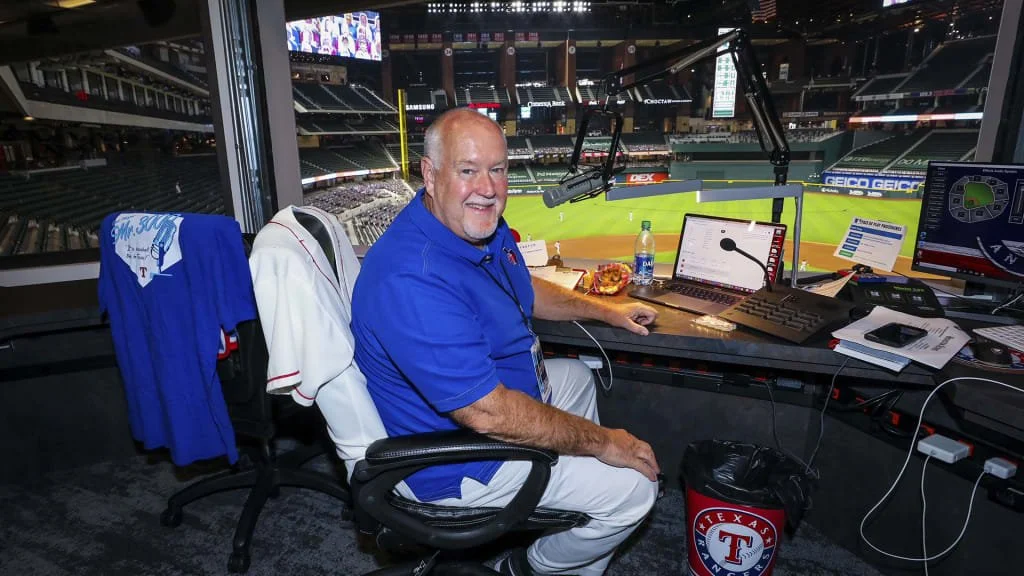
Robby Incmikoski: Go. All right, here we go with Chuck Morgan, the 88th interview for this book, which is going to be called Sacred Grounds. By the way, I really do think you’re going to like it, Chuck. Just so I have my facts straight: in 2025, is this your 47th or 48th year with the Rangers?
Chuck Morgan: This will be my 43rd season with the Rangers.
Robby Incmikoski: Okay, but you’ve been in baseball longer than that, right?
Chuck Morgan: Yes, I had three years with the Nashville Sounds in my spare time in Nashville.
Robby Incmikoski: How did you get into baseball?
Chuck Morgan: Well, it’s not the recommended route, but, you know, I had a lot of things going on in Nashville. In my spare time, I loved the game so much, and when the Nashville Sounds came to be in 1978, the guy that started it was Larry Schmidt. Larry was the coach at Vanderbilt University at the time—a baseball coach—and he knew me through my radio shows in Nashville.
I drove over one morning in December—it was snowing and I think I had a little bit of the flu—and I told Larry I wanted to be the PA announcer for the Nashville Sounds. Larry said, “We’ll pay you $10 a game,” and that’s how that got going. So for about three years, I did that. It was kind of tough on me—probably a little tough on Larry too—because I had to leave at nine o’clock at night to get to my radio show at WSM in Nashville. I did that for three years and finally had to stop because the Grand Ole Opry was taking up a lot of my time.
After all that, around the winter of 1982, I get a call from Larry just before Christmas, and he says, “I’m about to take a job with the Texas Rangers as vice president of marketing. I’m taking a shot in the dark here, but I want you to go with me.” And I said, “Well…” At that point, I was the CMA Disc Jockey of the Year, I was doing the Grand Ole Opry, my radio show had gone network by satellite. Larry King talked politics, I talked hillbillies. I had guests coming by, and the Nashville Network was just starting. We were churning shows out like popcorn, and I hosted a few.
I had all that going on, and after Christmas, I thought about it for a couple of weeks—am I going to be playing records when I’m 60? None of us knew records were going to disappear. But I changed my mind. I’ve always loved baseball; everything in my world revolved around the Cardinals having a good year when I was a kid. So a chance to be in the game… It’s funny now looking back. A couple years ago, I took my sons’ aide to the Grand Ole Opry—just on the tour—and we were backstage. One of my sons turned to me and said, “How did you give this up?” and I said, “Well, I never looked back. I’ve had such a great time in baseball.”
But Larry Schmittou is the guy that got me into baseball and brought me to Texas.
Robby Incmikoski: Are you from Nashville originally?
Chuck Morgan (03:36):
I’m originally from southern Illinois, a town called Marion. My cousin was Ray Fosse.
Robby Incmikoski: Man, I loved Ray.
Chuck Morgan: Yeah, Ray was a great guy, and we lost him a couple years ago. In grade school, he was the big high school star in several sports—football, basketball, baseball. He was being recruited to run fullback at Alabama by Bear Bryant back in the mid ‘60s. Great guy.
Robby Incmikoski: Let me ask you this, Chuck. Let’s get right down to it: the Dot Race. How did it come about, and why has it lasted as long as it has?
Chuck Morgan: Well, when I first came to the Rangers, we only had around 40 full-time employees—now we have about 250. I knew when Larry hired me that you can’t make a living as a public address announcer. I said, “What else am I going to do?” and he said, “Well, I’m going to make you the director of sales.” So that’s what I did when I wasn’t working games: selling program ads, fence signs, promotions, stuff like that.
The thing that changed everything was when ballparks added these huge video boards. At Nashville, we had a black-and-white matrix board with two lights racing each other across. Then around 1983, Larry had convinced ownership to add a DiamondVision for the ’84 season. He sent me out to Dodger Stadium in ’83 for the playoffs, because they had DiamondVision in 1980, to see how it worked.
We got the video board, changed game entertainment—suddenly you see great plays on the board. And around three years later, I was trying to sell a sponsorship to Whataburger, and I got to thinking about a race. It took me about a month to figure out how I could have a race on a video board. We had a very—what I’d call prehistoric—character generator with eight colors. So we started out with red, blue, and yellow. I animated these dots on the character generator.
The best thing is, I built a track out of railroad-model grass. First I put Arlington Stadium infield dirt around it, but it looked clunky under the camera, so I used cinnamon for the dirt. Then, with the equipment we had, I could superimpose the dots onto that track, like a weatherman with highs and lows. It’d take me about an hour a day to build a race. People thought I was a little crazy, but I said if a fan pays his way in, he deserves a different race every day. So I’d build new ones and add stuff to it. That’s how it took off. Really, it was me trying to sell a sponsorship, and we handed out a coupon—if your dot won, you took it to Whataburger and got a free Coke.
It’s evolved over time. When I went to Washington and saw the President’s Race, I thought, “What if we had live dots?” For a while, we had the track on the board, then we had the live costumed dots. We’ve done all sorts of expansions—like different areas of Dallas–Fort Worth, and they come through the gate at the end. But it was always to sell a sponsorship.
Robby Incmikoski: So you turned them into actual people running around in costumes. Was that the early 2000s?
Chuck Morgan: Yes, and a lot of people didn’t think it was the right decision, but I thought fans could “touch and feel” the dots. They hang out so people can see them. For the longest time, it was video. You asked, “Why has it lasted so long?” It’s so simple—no big concept to it: pick a color, root for it, done.
Robby Incmikoski: The reason I ask is, in-game entertainment evolves so quickly. Sometimes simplest is best. Give the fans something to cheer for, they have fun.
Chuck Morgan: Exactly, and another factor is the time between innings. You need something that lasts about a minute, maybe a minute ten at most. So the Dot Race is perfect for that. I try to keep it simple.
Robby Incmikoski: Chuck, for as long as you’ve been in the game—and I hope you’re here forever, but at some point we all have an expiration date—I almost feel like the Dot Race is going to go on in perpetuity. What pride do you take in creating it, and how is it such a crucial element of the ballpark experience?
Chuck Morgan: I don’t think about it much, but I’m happy people still get into it. They almost get into it more now than before. They hear the horse-race horn, know it’s time, see the dots run. I do take pride in it, sure. It was all to sell a sponsorship and make the team money, and it’s done its job over the years.
Robby Incmikoski: Yeah, you know in Pittsburgh, the pierogies…my buddies always bet a few bucks on it. I bet in Texas fans do that with the dots, too.
Chuck Morgan: Yes, it happens quite a bit. Probably the best story is from when George W. Bush, who was our owner at one time, had a friend named Larry Gatlin come out. Bush came into my booth and said, “Larry’s gonna want to bet on the Dot Race tonight, so tell him the wrong dot.” I did, and I think Larry lost some money.
You also mentioned the Presidents Race in D.C. When I saw that in 2010, I said, “We could do something like that in Texas.” For a while we had Davy Crockett, Jim Bowie, Sam Houston. We had a big-headed Nolan Ryan, too. Then we added Earl Campbell. But it all originated from the Dot Race.
Robby Incmikoski: Yes, I remember you had that big Nolan Ryan. Actually, let me pivot for a second. I was with the Twins once in Texas and saw the parachuters come in. One guy got stuck…
Chuck Morgan: Yes, I tell that story a lot. It was the Golden Knights Army Parachute Team, at night, and the guy got caught in the scoreboard. He hung there for a few innings. The Arlington Fire Department finally got him down around the fourth inning. The swirling winds made it tough. But that was definitely an interesting moment.
Robby Incmikoski: We only have a couple minutes left with my free Zoom, so I can’t thank you enough, Chuck. This is great.
Chuck Morgan: Hey, thank you, Robbie—appreciate it. If you need anything else, just holler.
Robby Incmikoski: I’ll be in touch as we go down the road, but yeah—let me stop recording here. Thanks again.