
Eric Nadel (Transcript)
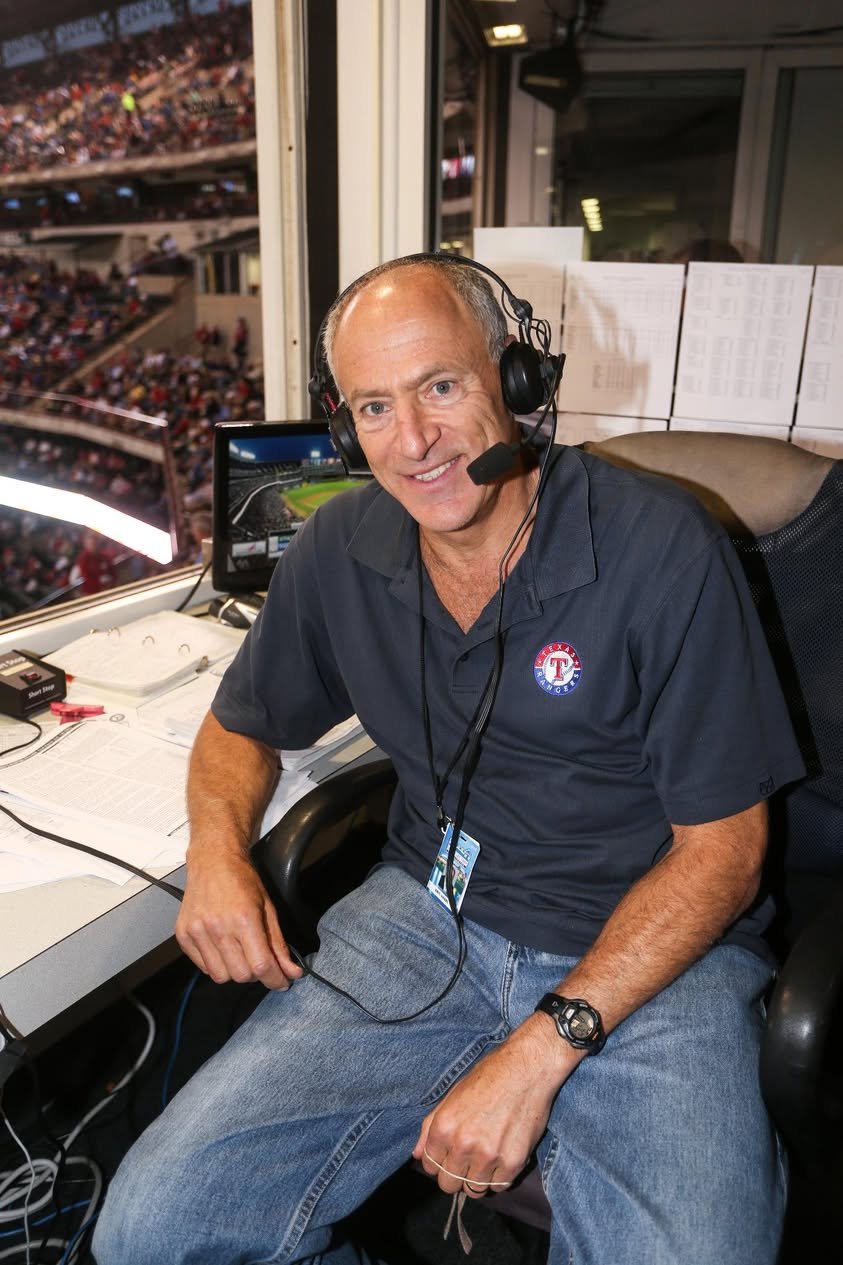
Robby Incmikoski: It's pretty cool to have a Hall of Famer in my book, Eric Nadel. Globe Life Field is only five years old, so there's not going to be a ton of stories from a five-year-old ballpark, but how would you describe the effect that Globe Life Field has had on baseball in Dallas? What I mean is, you had Arlington Stadium outdoors, you had Choctaw outdoors. Now you have a retractable roof. What is that vibe like switching to indoor?
Eric Nadel: It's changed the whole nature of baseball in the heat of the summer. The whole reason we have this new stadium is because when the old one was built in 1994, the technology for a retractable roof was not affordable. At the time that ballpark was designed, the only retractable roof in North America was on Skydome in Toronto, and the roof cost twice as much as the rest of the stadium. There's no way the taxpayers in Arlington were going to pay three times the cost of what they wound up paying in order to have a retractable roof. So that's why the previous stadium didn't have one. If it had been built four years later, it would have had a retractable roof—that's when the inexpensive technology for the roof got developed.
All of a sudden, you had all these other stadiums—Houston, Miami, Milwaukee, Phoenix—all within a span of one, two, or three years. In our case, and Cleveland's too which was built the same year, the stadiums were basically built too soon to get the retractable roof at an affordable price.
What Globe Life Field did was enable people to go to day games during the heat of the summer, which enabled the team to play getaway games during the day instead of at night. It enabled players to do extra work on the field during the day, which they couldn't do in the old stadium because it was so hot it would wear them out. It made the Rangers contenders for pitching free agents, which they never were in the past because pitchers never wanted to pitch in 100-degree heat. So it changed the whole perception of what it's like to play in Texas.
On top of that, the previous ballpark, because of the wind, was a hitter's paradise and a nightmare for pitchers. I remember one of the rare day games the Rangers had there in the heat of the summer, Brian Bannister was pitching, I think for Kansas City. He gave up a whole bunch of runs and was knocked out early, and he was asked after the game what pitching there was like, and he said, "It was like pitching on the moon."
Nobody wanted to pitch there. So with the new ballpark, all of a sudden, the Rangers became players for free agents who they never would have been in the market for before. You could go down the list of all the pitchers the Rangers have signed since they moved into the new ballpark, whether it's Gray or deGrom, or Scherzer wanting to play an extra year here, or the relievers Yates and Robertson. Pitchers did not want to come here and pitch in that old ballpark. So that's the biggest impact that Globe Life Field has had on the team itself.
Robby: Is it safe to assume that the retractable roof on that stadium could have in some way helped the Rangers win a World Series?
Eric: There's no doubt in my mind. The cumulative effect of playing in the heat at the old ballpark was just debilitating. At the end of a 10-game homestand, everybody would be completely wasted, exhausted, just dying to get out of town. When we would look at the schedule at the old ballpark and we would see a 10-day road trip during the summer, we would welcome it. If we saw a 10-day homestand, it was like, "My God, we're going to somehow have to survive this."
It's really changed everything with regard to conditioning of the players, being able to stay fresh during the course of an entire season. And yeah, I have no doubt that the ballpark made enough of a difference last year that the Rangers probably wouldn't have even made the playoffs had they been playing in the old ballpark.
Robby: That is unbelievable. I never thought of that angle.
Eric: That was part of what was used to sell the public on the idea of a new ballpark—and a ballpark that would have to have artificial turf, which people were very upset by. The baseball purists were all up in arms about artificial turf, not knowing that artificial turf now has advanced so dramatically from the days of the plastic grass in those multipurpose National League stadiums—Pittsburgh, Cincinnati, Philadelphia, St. Louis. That's what we all conceived of as artificial turf, or the rock-hard turf they used to have in Toronto. But by the time our ballpark was built, this Shaw Field turf and these other more modern artificial grasses are actually just as easy on a player's legs as natural grass, and the bounces are actually more true than on natural grass.
It took a while for people to accept that. They also expected that you would look at the grass or the turf and it would look fake, but they've developed it to such an extent that I've had people come into the ballpark for the first time and just look at it from the stands, and they never knew it was artificial turf—they assumed it was grass.
Robby: What is it like calling an indoor park home after calling 41 straight years of games at outdoor ballparks?
Eric: It's actually really refreshing. We used to sweat our asses off at the old place. We would keep the windows closed until right after the national anthem, and we could never really get the temperature cool enough to be comfortable. Even with the windows closed, it would be maybe 78 in the booth. When we would open the windows, we had a thermometer in there, and we would just watch it climb up into the 90s. By the time a game was over, we wanted to change clothes, we wanted to go home and jump in the shower immediately, and we were just exhausted. That's not the case anymore.
It makes a huge difference in the ability to concentrate, the ability to focus for three hours or three and a half hours—it's so much easier. The trade-off, of course, for me is that in this new ballpark, the broadcast booth is considerably higher up, so I don't have quite as good a read on the ball coming off the bat. It's harder for me to describe players, so I use the TV monitor more. But I wouldn't trade for an instant and go back to the old ballpark where I could see better but was sweating to death for half the home games.
One of the really interesting things, though, about when this ballpark opened—we opened during COVID, so we had no fans. The season didn't start until the end of July, and we had cardboard fans. So when we started working in this ballpark for the first time, not only were we in a new vantage point that we didn't particularly like as much, but there was no background noise, no ambient noise, no excitement in the building. We had to provide all the energy ourselves.
It was amusing to see the cardboard cutouts of fans, but it didn't provide us with the energy that we kind of thrive on when we're doing a broadcast. The Rangers opened their previous ballpark in Arlington during a player strike, so the season didn't start until late April. And the Rangers opened the original Arlington Stadium during a player strike. So all three Rangers stadiums have been somewhat cursed or haunted in their opening by a stoppage or a pandemic or something weird that prevented them from having a traditional, celebratory first season in a ballpark.
Robby: What did that ballpark do for the community and, most importantly, the Rangers fan base? The support seems so good—what drives that, do you think?
Eric: Even before the World Series, we averaged 28-29,000 last year. This year it's up closer to 33,000. It's an experience to go to the ballpark, and it's a way of getting out of the heat. It actually now is a refuge for people to get out of the heat instead of having to tolerate the heat in the old ballpark, which people didn't want to do. So people might stay home and watch the game on TV when it's 100 degrees here, but now they want to come to a game and sit in 74-degree comfort for a few hours. So it's exactly the opposite.
Plus, the whole experience of being in the ballpark is something new for a lot of people who still haven't been there. They're still coming for the first time, and when they come, it's such a pleasant experience that obviously they're going to come back. Whereas in the old ballpark, they'd come out to a game in the summer, they'd roast, they'd be completely wiped out by the sixth inning, and not likely to come back. Now, people who come out the first time are much more likely to come back and do another game.
Robby: How does one guy stay with one franchise for 46 years? What is the key?
Eric: The key is not pissing off the critical people who make the decisions. That's basically it. I think having them know that you're loyal to the organization and that you're a good guy and people like you makes it a lot harder for them to get rid of you.
In my case, I was a hockey announcer when I'd never done a baseball game. I got hired in 1979 from the Dallas Blackhawks who were the Chicago Blackhawks and Toronto Maple Leafs Triple-A team in Dallas. I was allowed to grow into the job on the job, largely because the Rangers were such a cash-starved franchise at the time. I was already in town, they didn't have to pay moving expenses, they liked the way I did hockey, and they were willing to wait for me to learn how to do baseball on the job.
But the big reason I kept the job was I was also selling advertising for them, and I was doing well at that—making money for the powers that be, which, in that case, originally was actually the city of Arlington. They owned the broadcast rights in a weird arrangement—that's how they got the team to move from Washington to Arlington, by buying the broadcast rights in advance for 10 years.
I was really fortunate in having an amazing partner in 1982. They hired Mark Holtz away from the Dallas Mavericks to be the main play-by-play guy, and I was his sidekick. I think we were a perfect duo in terms of chemistry and what we offered to the broadcast. That's pretty much how I got my legs under me, and also became accepted as actually being a good baseball announcer, largely due to the duo with Mark Holtz. The whole was greater than the sum of its parts, and I think people were perceiving me in a more positive light than they otherwise might have because I was part of this amazing duo.
Robby: There's a story, if you recall, you and I in the lobby of the Carlton in downtown San Francisco. Would you be willing to tell that story of who you beat out for a job?
Eric: When I was the voice of the Muskegon Mohawks in the International Hockey League in Muskegon, Michigan, from 1972 to 1975—this was the '74-'75 hockey season—I was the announcer for the Muskegon Mohawks. All the announcers in that league knew each other. We were all trying to get out of that league, all trying to move up to higher levels of minor-league hockey on our way to the National Hockey League, we hoped.
So we would apply for every job that opened up. I read in The Hockey News, probably in February that year, maybe March, that a job had opened up in Oklahoma City with the Oklahoma City Blazers, Toronto's Triple-A club. I called there and talked to the general manager, who was also the coach—Ray Miron was his name. He said, "The job's wide open," so I sent him my resume and some tapes.
He called me back a month or so later and said, "You're one of two finalists for the job, and I want you both to fly to Montreal for the annual hockey meetings in June. I'll take you to dinner one night and I'll take the other finalist to dinner one night, and then I'll decide who gets the job."
I was the one who got to go out to dinner with him the first night. He was a real good-time guy—he loved having a good time and he loved to drink. As soon as I sat down at dinner with him, he immediately ordered a drink, so I ordered a drink. Then he ordered another one, so I ordered another one. As the evening went on, we had a lot of drinks and had a really good time telling stories and laughing and talking about our mutual acquaintances in hockey.
I remember going back to the hotel after the dinner feeling extremely inebriated but also feeling extremely confident that I'd really done well and this guy had really liked me. The following night, when he was going to interview the other guy, I went out to dinner with some other friends. When I came back to the room, I got a call from Ray Miron late that night, and he said, "Hey, Eric, this is Ray. I just wanted to let you know that you got the job."
I said, "That's great, thank you very much."
But he said, "I've got this problem. I don't know how to tell Mike Emrick that he didn't get the job."
As it turned out, Mike Emrick went on to be the Vin Scully of hockey broadcasting—the most decorated American-born hockey announcer in the history of the sport. He did countless Stanley Cup Finals and Olympics and every major marquee hockey event there was to broadcast.
I think I got the job because I probably drank more than he did. Knowing Mike, he probably had a beer, maybe two, but he probably didn't drink all night with Ray. Ray was looking for who would be his wingman on the road—somebody who he would go out with after the games. He couldn't go out with the players, and the trainer on that team, as I later found out, didn't drink. So the broadcaster was going to be the only guy he had to hang out with after the games, and I probably was a better partner for him for the kind of fun that he wanted to have. I'm convinced that's why I got the job, because the concept of me getting a hockey play-by-play job over Mike Emrick is ludicrous. It would be like me getting a baseball job over Vin Scully—it's absurd.
Robby: That's one of the greatest stories that'll ever go in this book. Are you in the Hall of Fame? Okay, so I think things worked out pretty well for you.
Eric: It worked out great for both of us. We've joked about it. He's won every award hockey has to offer.
Robby: What makes baseball on the radio so special in your opinion?
Eric: I think what makes it so special is the conversational nature of it, compared to other sports. The fact that it's relaxed. So much of it is what you say when the ball is not in play. It's the relationship the announcer develops with the fans when he's just talking to the fans. The ability to use your personality is so much greater than in any other sport because of all of the dead time and because of the pace of the game.
I think the announcer connects with the audience on a much deeper level than in any other sport. And because it's the summer and people are doing a lot of activities with the radio on in the background, baseball is the perfect soundtrack for whatever people are doing. It's really nice as background noise. You don't want to listen to a hockey game as background to whatever you're doing because it's too exciting, or a football game. Those sports are too exciting all the time. Baseball has a few exciting moments sprinkled into three hours of conversation.
It gives the announcers much more of an opportunity to connect with the fans, and for the fans to feel that you're part of their family or you're part of their group of friends. We hear all the time from fans, and it's the best thing we can hear: "We love inviting you into our living room or into our car, and you feel like we know you." Those are the nicest compliments we get.
Robby: That's amazing. Is there anything else you'd like to add about the ballpark?
Eric: Another thing about this ballpark I really like is the way it's steeper than any other ballpark, creating sightlines that to me are much better. The old-fashioned ballpark had a super gradual incline on the lower deck, which made the upper deck much farther from the field. Comerica Park in Detroit is a perfect example of that—the lower deck needs a much steeper incline. The upper deck seats are much too far away, and half the seats in the lower deck are too far away because the incline is so gradual.
In Globe Life Field, the pitch is steeper than in any other park, and it starts with the lower deck. A lot of ballparks, like the new Comiskey in Chicago or whatever they're calling it now, the upper deck is super steep but the rest of the ballpark isn't. Our ballpark, each deck is steep, and they're stacked on top of each other, which creates more of a feeling of intimacy. It's one of the reasons that I like the ballpark so much.
Robby: What is it like having a former President of the United States in attendance at baseball games?
Eric: It's really special. The elder Bush didn't really go to that many games—he went to more games in Houston. But George W., remember, was the managing general partner of this team for five years. Not only did he go to all the games, he was on the field during batting practice almost every night, and he would sit with us in the dugout.
We were actually taking Spanish lessons at the same time. I was taking them so I could talk to Ruben Sierra and Juan Gonzalez and other Latino players. As it turned out, he was taking them so he could run for office and appeal to the Hispanic population in Texas when he was running for governor a couple of years later.
Seeing that he still takes the trouble to come out really pleases us. For me, seeing him out there is great because I know he loves listening to baseball on the radio. When he was the governor, we had him as our guest one time, and he said on the air, "I love listening to you guys. I sit out on the veranda at the Governor's Mansion and listen to the games every night, smoking a cigar."
So when we're always wondering who's listening, I would always imagine that I was talking to the governor, who was sitting out there smoking a cigar. When he would be on the air with us—when he was the owner, when he was on the air with us, and the ball would be put in play—instead of pausing so that I could describe the play, he would do it. He had all of the phraseology; he knew how to do baseball play-by-play. He could describe a double up the alley as well as anybody. So it was one of the things that made it so much fun to have him on the air with us.