
Marty Brennaman (Transcript)
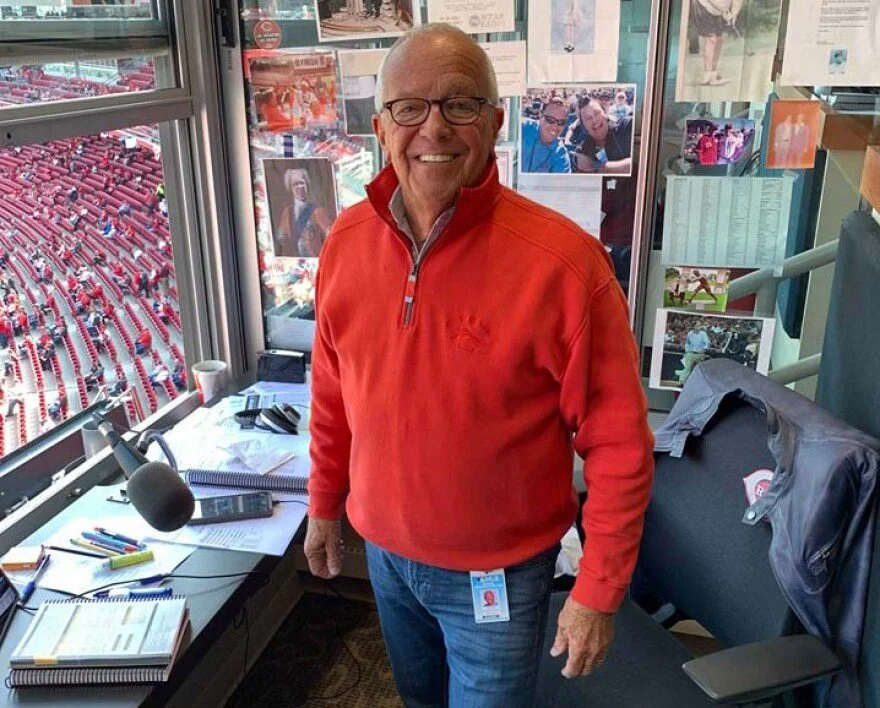
Robby Incmikoski: All right, here we go with Marty Brennaman, interview number 104 for the book "Sacred Grounds." Marty, can you just explain to the viewers and to the fans out there what it is like being part of the Reds culture for over four and a half decades, and what the Reds mean to the game of baseball?
Marty Brennaman: Well, that's a good question, Robbie. When I came, I did a little bit of homework ahead of coming to work, and when I went on the payroll February 1, 1974, about the organization, about the history. But I think really, when you consider it being the oldest professional baseball franchise, you have to live it on a day-to-day basis over a period of time to truly appreciate what a special honor it was to work in this organization—and no other organization over my 46-year career as a play-by-play guy.
With each passing year and with information given to me over a period of years about the individuals and about the background of the franchise, it really made me appreciate it. It was a growing appreciation over a lot of years to realize the great, rich history that this franchise has and continues to add to. But it's almost magical to think back to some of the... [call was temporarily interrupted]
Okay, so basically, that's the way I would answer that question—that it's different from any other franchise, if for no other reason, it's been around longer than any other franchise. Harry and George Wright were the two guys who formed the club back in 1869 when they were the Cincinnati Red Stockings, and it has just simply grown from that historic moment to where we are today.
Robby Incmikoski: Marty, baseball spans generations, and there are many generations who might not be quite aware of just how deep the tradition of baseball goes, like you mentioned a moment ago, in the city of Cincinnati. What kind of responsibility did you as an announcer feel to kind of marry that history a little bit with the current day ballclub that you were broadcasting?
Marty Brennaman: Well, I think it was relatively easy. I think back to some of the people that I followed, going back to Wade Hoyt and the people that followed after that, most notably Al Michaels, who I replaced. Al was only here for three years and then left to go to the Giants, and we all know what kind of career he's had since leaving Cincinnati and San Francisco.
We would have occasion to reflect back, whether it be a play that occurred on the field, or whether it be offensive milestones, so to speak, that you could reflect back upon—something that is similar to or exactly like what happened back in the 1953 season, or something of that nature.
I really had to go back. Once I got on the job, I was given volumes of material to study. I was given yearbooks, which were really big back in the day—each club would put out a yearbook every year, and it would be color. I've got a whole bunch of them still today, probably the ones that the club gave me that went back to the early 50s, up until the time I took the job in 1974.
I was given books to read about the history of the franchise, and I did my due diligence. I think it would be much easier today than it was back then, because of social media and having access to things like Wikipedia and other information websites that you can go back to check on anything under the sun. But back then, it was reading material that had been printed, reprinted over the years, and it made it a lot easier to cross lines and go from season to season, because you have this material available to you that makes it a whole lot easier to understand how great the franchise has been.
Robby Incmikoski: Can you just give me a quick story—back in 1974, how did you get the job, Marty, and when you got it, how long did you anticipate being in Cincinnati?
Marty Brennaman: Good question. I got the job... I was in Virginia, working for a radio station in Norfolk, WTAR Radio. They had been awarded the rights to the ABA franchise that had moved out of Washington, DC into Virginia, which became known as the Virginia Squires, and that's the reason why I went to Virginia and did their games for three and a half years.
But along the way, I did three years of Triple-A baseball. At that time, it was a New York Mets Triple-A farm club. Now it's Baltimore, and I did their games for three seasons, traveled full-time with the ballclub and gained really incredible experience at that level of doing professional baseball.
In 1973, Major League Baseball had their winter meetings, their annual winter meeting, in Houston, Texas, and it was a chance meeting between Dick Wagner, who was the assistant general manager of the Reds at the time, and the general manager of the Triple-A club, the Tidewater club in Norfolk, Dave Rosenfield. They just happened to run up on each other, and they were chatting.
In the course of the conversation, Dick Wagner happened to mention that their lead announcer, Al Michaels, had left to go to the Giants, and they were searching for someone to replace him. And Dave Rosenfield says, "I have a young guy doing my games in Norfolk that does a pretty good job." And they said, "Tell him to send me a tape." I sent a tape and, to make a long story short, they told me after the fact that 221 people applied for the job, and I was fortunate enough to get it. That's the way it happened.
Robby Incmikoski: Do you ever look back on 46 years—or I guess I should say, how often do you look back at 46 years with one franchise? And what kind of pride do you have in that, Marty?
Marty Brennaman: I have great pride in it, Robbie, because there are only a handful of guys that have done 40-plus years of Major League Baseball, and they did it for only one team. So I take tremendous pride in that. And I also pat myself on the back, not for being talented, but also for being damn smart, because of all the opportunities I had to leave and go somewhere else, at the end of the day, the decision always fell in favor of staying where I was.
I only really came close once, and that was going to the Boston Red Sox in 1981. For whatever the reason, I turned that job down, and in retrospect, looking back on it, I don't have any regrets at all about staying here. And that has more to do with the city of Cincinnati and the people that reside here than it does the baseball part of it. It was hard for me to leave this town because I had such a great love and admiration for it.
I think our business is very transient, because most guys think the grass is always greener somewhere else. And thank God that did not infect me, because I felt like, "Why do I want to go anywhere else?" I mean, people go for money, obviously, and I can name a lot of guys that went for the money and regretted the decision after they got where they ended up.
I was blessed to come here and develop an affection for this town that is unparalleled, because I don't think there's anybody who was born and raised here that loves this city any more than I do, and I came here as an outsider. So that's the biggest thing—I was happy enough here because of my lifestyle, that I didn't want to go anywhere else, and thank God I stayed here for 46 years as a play-by-play guy.
Robby Incmikoski: That's amazing, amazing. We'll move on to some baseball now. Thank you for that detail and insight into your career, because I know a lot of fans are going to be excited to read it. Marty, you mentioned how great the fans are and how great the culture is for baseball in Cincinnati. I've been fortunate to spend three opening days in my time with the Pirates in Cincinnati for opening day. There is no better opening day in all of Major League Baseball. What was it like for you 46 times over?
Marty Brennaman: Well, I would say it's the single biggest day on the calendar every year. It transcends everything—any kind of festival that they may have here, any kind of incredible concert series they might have here. It transcends everything. There's nothing in the same league with opening day in Cincinnati. And I always look forward to it. I look forward to it today, even though I have a contract with the Reds to make appearances and things like that.
But I always look forward to it because, you know, for many years, it was the opening day game. Nobody opened before the Reds did. Obviously, that all changed over the years because of the almighty dollar and rights fees, etc. But for many of the 46 years, it was the opening day game. And there's so many things that make this one stand out apart from other opening days.
Having been around 46 years, we were many times the opening home opener for whoever it might be. Even though we opened at home all the time, we might play a series and then go on the road and go to Los Angeles and maybe it was the home opener for the Dodgers, or a home opener for the New York Mets, or whatever the case might be. So we experienced opening days in other cities, and I can tell you from experience that there's nothing that I've been to that equals what we do here.
And it goes back to all the different things that occur for opening day here that don't in other cities, like kids being able to get out of school if they have a ticket to go to the opening day game, or the Findlay Market parade. Findlay Market is an ages-old meat and produce market in the center of town that has an incredible history behind it, and every year they sponsor the Opening Day parade.
And then all the pomp and circumstance that goes on on the field before the first pitch is ever thrown. It's just a unique, unique day that sets this city apart from any other major league city when opening days are discussed. There is nothing comparable to opening day in Cincinnati.
Robby Incmikoski: No, I agree. There's no better place to spend opening day in the United States of America than Cincinnati, Ohio.
Marty Brennaman: Yeah, there's just nothing that compares to it.
Robby Incmikoski: Can we discuss the ballpark a little bit? It's widely known as a home run hitting ballpark.
Marty Brennaman: Sure is.
Robby Incmikoski: What is it like for a broadcaster on both sides, knowing that the Reds can hit a ton of homers—and you saw Todd Frazier in the mid-2010s hitting a million homers, Joey's hit a share of homers—and then you see other teams coming in, guys hitting a lot of homers. What's it like calling games in a home run heavy ballpark?
Marty Brennaman: Well, you hit the nail on the head—it's a two-way street. We've seen a lot of Reds players hit a lot of home runs and have big years because fly balls go out of Great American Ballpark, but on the other side of the coin, the same holds true for the teams that you're playing.
I think it's hurt this team over the years, quite honestly, because especially with free agency still so big in Major League Baseball, there are a lot of guys that don't want to come here and pitch, because it's not an easy thing to do.
It's exciting for the fans, because they love to see balls flying out of ballparks. It doesn't make any difference where it might be. And so it's made for some monumental moments—Scooter Gennett's four home runs in one game here; Joey Votto, I think twice, hit three home runs in a game, including a game-ending grand slam. There are so many things that go into watching a ball game here at Great American Ballpark.
Now, obviously it's not like—if people would automatically say, "Well, it's like Coors Field." Well, not exactly, because I think there are leads that are safe here in our ballpark. I don't think there's ever a lead safe in Coors Field in Denver, and I've seen that up close and personal over my many trips into Denver to watch the Reds and Rockies play.
It's kind of interesting the way the ballpark was laid out. I say that because there was never any question about the way it had to be. You don't have ballparks built where the sun can be a factor in the ability of the hitter to see pitches that are coming 95 or more miles an hour to the plate because sunshine gets in their eyes. And so there is a way that it has to be laid out.
And it's unfortunate that we could not have had this ballpark face the skyline of Cincinnati as the ballpark in Pittsburgh does. To me, that's one of the most picturesque ballparks in the history of baseball, because on any night, you could look out beyond the walls and across the river and you see a beautiful skyline that Pittsburgh has. And the same would have held true had they been able to do the same thing here, but they couldn't do it.
We look across the Ohio River into Kentucky. That's not the worst view in the world, but nothing replaces seeing a skyline at night, especially if you're in a big league ballpark. But it's a nice park. Sometimes I see people rate them, and this ballpark is not rated among the best, and I'm really kind of surprised, because I wonder to myself, "What is it about this ballpark that you don't like?"
I was attracted to it when it opened, whatever it was, 23 years ago, and along the way, over those years, the organization has done a great job of maintaining plus adding to it. Because baseball has become now a night for the family at the ballpark, and there's not one that doesn't have something for kids to become interested in. They've done a wonderful job of keeping the ballpark fresh, bringing in new attractions that may not have been there the year before, and I think that all goes into planning and not wanting to hear anybody say this ballpark is outdated.
As great a ballpark as I found Camden Yards to be in the couple of times I worked there during interleague play, I really felt like that ballpark had gotten tired and had not been addressed in the manner in which our ballpark has been addressed over the years.
I think it's important. I think the greatest example of all of that's Dodger Stadium for me. Dodger Stadium looks brand new. I always marveled at the wonderful job that those people did, and that's why that's one of my top three ballparks to work in, outside of ours here, because they've done a great job of keeping that ballpark fresh. And we're talking, next to Wrigley Field, about the oldest standing ballpark in Major League Baseball in the National League. So that's pretty much my look on that type of thing.
Robby Incmikoski: Marty, what else is interesting about it—I'm gonna let you roll in a couple questions here—but the one thing that always stuck out to me with Cincinnati is how they preserve and honor the traditions. You got the riverboat deck in center, you got the power stacks, you got the silent tribute to Pete, and then you got the toothbrush lighting, which is a tribute to Crosley Field. I mean, how cool is that, that there are so many things that honor the history of baseball in Great American Ballpark?
Marty Brennaman: Well, again, it goes back to the fact that this ballpark is steeped in history, as we talked earlier, and the planning of this ballpark to incorporate all of those things that reflect back on other parks and other times and other personalities make it very unique.
In fact, when you think about other ballparks, I don't know that anybody went to the extreme that they did here in designing this ballpark with an eye toward the past. I think it certainly stood this park in good stead, because I think anybody who comes to this ballpark now for the first time and sees the layout and sees things that would have them scratch their heads and wonder what that was all about, hopefully those people are with someone who can explain to them—just as you mentioned a moment ago—about the riverboat and the twin stacks and things of that nature, and why it was so important to include features like that in this ballpark, because it's in the city where the game was first played.
Robby Incmikoski: Marty, when you eat before games, you go in that press room, and a lady named Denise Thomas is also going to appear in this book with a story like you are. And there are so many people as you travel baseball that you, I'm sure, have gotten to know their faces and their names that you see once a year, maybe two, three times a year, if they're in the same division. But people like Denise, how do they make the baseball experience special, just with their personality and how much they love the game and they love being around people?
Marty Brennaman: Well, you're talking about one of my favorite people of all time. I had such a great relationship with her because I admired her personality, her sense of humor, everything that makes a person memorable in a good way, and she did that. And it wasn't restricted to just the guys that come in every night because they're with the home club, but it included people like yourself and other broadcasters and other writers representing the newspapers of the cities that we played on a day-in, day-out basis. They all knew her by her first name.
And I think that, above all the people that may be memorable in press dining rooms around Major League Baseball, or at least when I was there—I've been gone now for this sixth season, and people change, and things change just like everything else—I don't know that there was anybody who was more of a dominant personality in a good way in a press dining room than Denise Thomas.
And I know every year in wintertime, we'd be away from the park and away from people, and periodically, I'd dial her up and talk to her. Then we'd look forward to seeing her on opening day and throughout the course of the next season. She's just a very, very special lady who certainly made her mark at Great American Ballpark over and above so many other people.
Robby Incmikoski: Marty, I have other people who fans are not going to know by name. They're not going to know their face, but they're so important behind the scenes. I'm talking Boyd Robertson, stage manager, worked with Vin Scully for 28 years. You got Denise. I got ticket sales reps. I got beer and lemonade vendors going in the book, Marty, just the people of baseball. How much do people make baseball special, no matter what their role is, no matter how much money they make or how often you see them? How much do people make this game special, in your opinion?
Marty Brennaman: Well, more so than any other sport. But I think you hit the nail on the head. It's because of the number of games that you play. It's not a National Football League game where you might see someone that you think is very special. You might see them 18 times, or whatever the number would be, including preseason games. In baseball, you talk about 81 games, and it makes a major difference—more so in this game than in the NFL or the NBA or the NHL, or whatever other sports you might throw in there.
By virtue of the number of games, these people become much more special because of the repetition over the course of a sport that begins today in late March and doesn't end until the end of September or the first weekend in October, depending upon how the calendar falls. So I think that's the biggest single thing—that people are much more memorable when it comes to baseball than in any other sport.
Robby Incmikoski: Marty, if there is a fan out there who had never been to Great American Ballpark, where they want to come see the Reds or just experience an opening day or come see their favorite team play as a visitor in Cincinnati—people who have never been there—what would you tell them the experience is like and what can they expect?
Marty Brennaman: Well, they can expect a lot going on inside the ballpark. But aside from that, I would recommend that if people come here for the first time, to begin with, they stay in a hotel downtown. That way, they park their car and never have to drive it again until they leave to go home, wherever that might be.
They can walk across the bridge, across Fort Washington Way, which is a main thoroughfare, and come to the ballpark if they're staying there, or they can stay in Northern Kentucky and walk across the bridge to the ballpark.
And once there, they need to see some things outside the park. They need to see the bronze statues that have been erected of Ernie Lombardi and Frank Robinson and my old partner of 31 years, Joe Nuxhall, and Pete Rose and Joe Morgan, etc., etc., Johnny Bench. They need to see those bronze statues, which are outside the ballpark.
And then they need to go into the Reds Hall of Fame Museum, which is something unlike any major league baseball team. Nobody has a hall of fame museum like they have in Cincinnati. The only one that would be comparable to it would probably be the best sports hall of fame museum, and that resides in Green Bay, Wisconsin. This one is unlike anything you might see in Major League Baseball, and it does nothing but take you down memory lane, going back to the beginning.
It's just an amazing museum. If anybody comes to Cincinnati and watches the Reds play and leaves town without going to the museum, they've really done themselves a disservice. So they're the things that they need to be aware of when coming here—by all means, see the bronze statues and also go to the Reds Hall of Fame Museum.
And enjoy the area around the ballpark. There are good restaurants. There are great sports bars. The Holy Grail, which is right across the street, is one of the great sports bars—baseball and football. The Bengals are represented too, but not to the extent that the Reds are inside the bar across the street, and it's a great one.
So it's just the area around the park, and then inside, when they're watching a baseball game, you can walk completely around a concourse. And I think that, to me, would be something that people would enjoy, that would give them a chance to see the ballpark from so many different directions and really take it in for all of its advantages and for all of its worth.
Robby Incmikoski: Marty, I wrote my intro because this is a website along with a book. I said those two exact things. Number one, the Hall of Fame Museum is unmatched. There is nothing better. It is unbelievable to go in that hall of fame. But the other thing I said, Marty, I don't think I've ever seen a statue in my entire life that depicts a player in a more appropriate pose than Pete Rose. Would you agree with that?
Marty Brennaman: Oh, absolutely, no question about it. I'm talking in all sports, anywhere you go.
Robby Incmikoski: That is no—I agree to a nutshell. Hair flying, elbows in the ground, head-first slide. That I used to... when I was a kid, when he played for the Phillies in 1980. Yeah.
Marty Brennaman: Well, that's a credit to the guy that designed them, a young, very talented guy named Tom Tsuchiya. He's amazing. Out of making all the bronze statues that are out in front, around the ballpark, outside the gates, he now does all the plaques for the Baseball Hall of Fame in Cooperstown, for every induction. He's the guy that does them now, and he's very talented. He did every one of these bronze statues.
Any credit for that certainly goes to him, because it's almost like it's really moving when you see Pete in suspended animation, head-first slide, his hair swept back because the wind has blown his hair backwards as he approaches at a dive of a base. It's spectacular. It really is.
Robby Incmikoski: It's the best statue. I've never seen in my entire life. I've seen a lot of good ones because I'm into photography and ballparks and attractions, and there's nothing like it, nothing.
Marty Brennaman: That's true.