
Dallas Braden (Transcript)
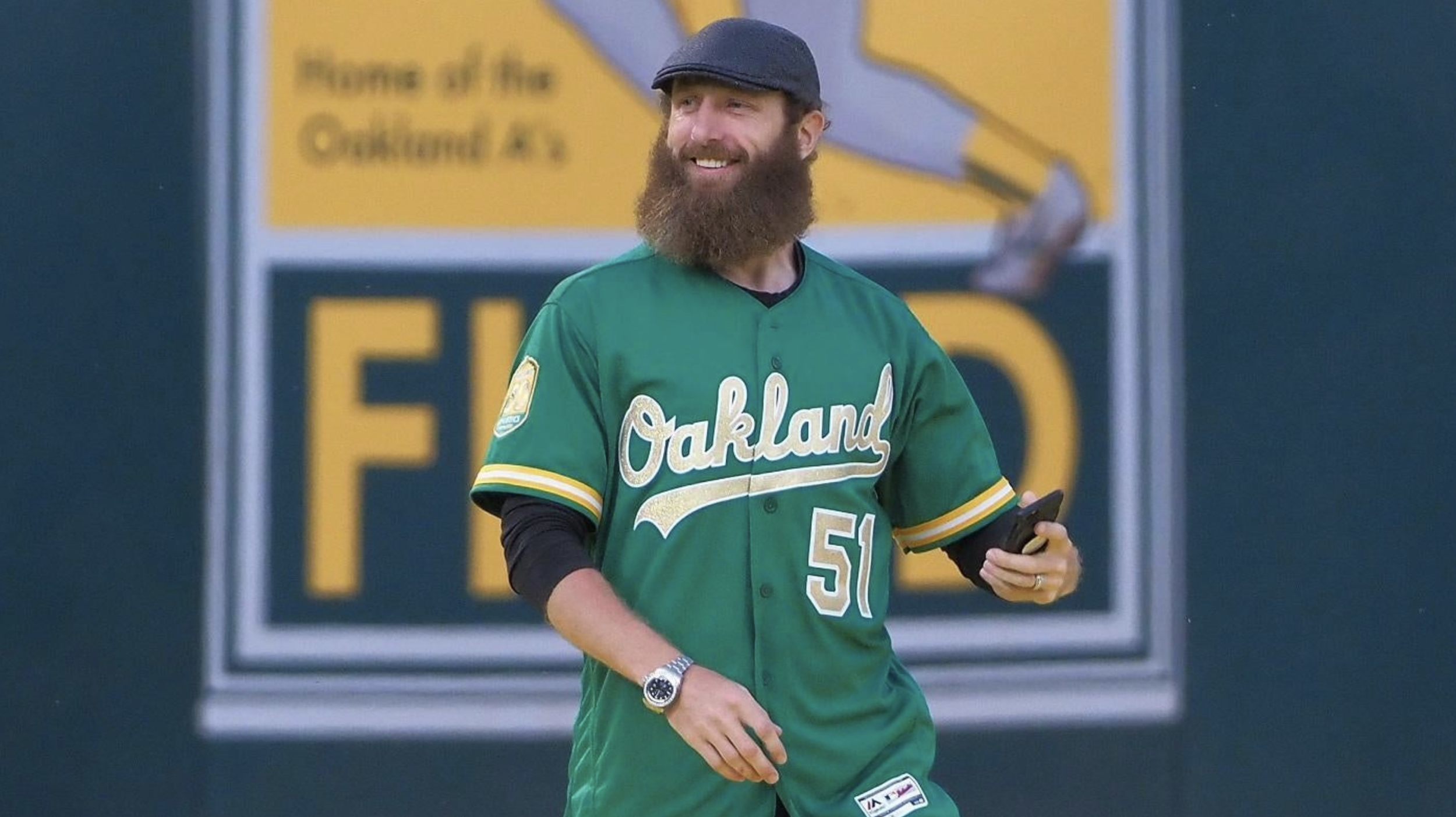
Robby Incmikoski: All right, here we are with the Z-man, Mike Zagaris, interview number 89 for the book. Hey, Z, how many years were you the team photographer? How many years did you take pictures in the Coliseum for the Oakland A's? Just for baseball, not football.
Mike Zagaris: Actually, for the A's, I started in 1981. It was Billy Martin's second year. And it was really the first year of Billy Ball, after the Haas family had bought the team. I had shot there—I started shooting the A's basically for baseball magazines and baseball cards in 1972-1973, and those were part of the teams that won back-to-back-to-back World Series. It was a dynasty.
Nobody was there. I mean, the Coliseum was empty. And when the World Series would come, it would fill up. I'll never forget the 1973 series between the Mets and the A's. The first two games were in Oakland. I remember my dad drove down from Reading, and we were going to buy seats to the first game. No need. Tickets were for sale. We ended up sitting in the third deck. The last three sections on each side of the third deck were almost empty. There was no bunting. That was Charlie Finley—great ball club. Charlie was cheap as hell.
He was an innovator in many ways, but not really liked by the players. He was cheap as hell, and all those years, I've got some pictures where Reggie Jackson is swinging and there's nothing but empty seats from basically the first base dugout all the way to the outfield.
And then, once the Haas family came in that first year, they hired Crazy George to help boost the fans, and he'd get on top of the dugout and beat his tambourine and scream and yell. We had almost 3 million people. Great Billy Ball campaign, they spent a lot of money. The place was rocking.
The A's season was split into two halves because of the strike. The A's won the West the first half. I think they were second to Kansas City in the second half, then they ended up losing to the Yankees in the playoff. But it was an exciting team. We had a great pitching staff, and it was a whole new era, and that's how I started actually working for the team. It was that year, and it was unbelievable.
Robby Incmikoski: Wow. Now let me ask you this. I'm going to get a couple highlights here, because I really want to celebrate baseball in the city of Oakland, and it's a shame, obviously it's not there anymore. We'll get to that in a moment. But do you remember young MC Hammer being a bat boy at all?
Mike Zagaris: I remember MC Hammer, and I remember the players were friendly to him, but when he wasn't around, they said, "Watch out, that kid's a spy for Charlie," because he'd be in the clubhouse all the time as the bat boy. And the word was that anything he heard would go up to Charlie. That was MC Hammer.
Then MC's career took off as an entertainer, and he came around. I'll never forget he was there, I think, to throw out the first pitch or to maybe sing an anthem in '88 or '89 for the World Series, for the playoff games.
He was also at that same time—the 49ers got Deion Sanders in '94. And MC was recording an album, and Deion loaned him a lot of money. And MC never paid it back, because MC and his brother, they were building this huge house in Fremont, and they were really into the horses. When I say into the horses, they loved horse racing. They had a few horses. They loved to bet. And that's where the money went. That was MC Hammer.
Robby Incmikoski: Hey, how would you describe baseball in Oakland? What did it mean to the fans? What did it mean to the city, and what did that Coliseum, even though it was a dump—there's no doubt it was a dump, but I love that place. Mike, I loved working there, even though it was a dump. Just, how do you describe what baseball was like at the Oakland Alameda County Coliseum?
Mike Zagaris: It was great. It was a celebration. It was different, yet similar to what it used to be like in Emeryville at the old Oakland Oaks ballpark. It was homey. I always equated Oakland to Baltimore as a city. They're almost sister cities. It was a very blue collar, middle class, working class crowd, and they loved their team.
Part of it was the Giants were the first team in the Bay Area. And the Giants were like the rich kids. Oakland was always scrappy. I look at Oakland as far as city rivalries—Oakland was the Mets to the Yankees. Oakland was the White Sox to Chicago's Cubs. And they were incredibly proud of their team. They love their team. When you won, they showed up.
When the Haas family—when we won in '88, '89, and '90, that place had almost 3 million people a year, and it was rocking. It was dynamite for a photographer. I thought it was the best place to shoot for two reasons. First of all, there was nothing in front of the dugouts, no screens or anything. And above and beyond that, it was a much more relaxed atmosphere than you certainly got on the East Coast and in most other ballparks.
I used to shoot, I could sit on the steps before the game and banter with the opposing players, many of them were friends, and managers, and it was as relaxed and old school of an atmosphere as you'd ever hope to find. In a way, it was a dump, but it wasn't bad.
The one thing I never liked about it—there was too much foul territory, because it was built to house both baseball and football. But other than that, before they put up Mount Davis for the Raiders' return, it was actually a great place to see a game. As far as you had the bleachers in the outfield, you could look beyond the bleachers, and you could see the hills of Oakland. It was a great place to play and a great place to be.
The fans in Oakland, whether it was the Athletics or the Raiders or the Warriors, they were rabid. They were there. Especially in the '70s and early '80s, the players after games could hang out with the fans. It was an atmosphere that doesn't exist anymore, really, in professional sports, because what's happened now, especially with football and basketball, but even baseball in a lot of big cities—it's a corporate ticket. It's hard to be able to afford to bring a family to a game with the ticket prices and the price of concessions and parking.
In Oakland, it was baseball from another era, never to be repeated.
Robby Incmikoski: There won't be. There's no way that we're gonna see baseball like we saw it in Oakland. It was amazing. I love being there as a visitor, which reminds me of something. Speaking of visitors, how do you describe, Z—and you've walked through this thousands and thousands and thousands of times over—how do you describe that tunnel leading from the visitors clubhouse to the dugout, how small it is and how they have to share it? The team has to share it with the fans?
Mike Zagaris: It's one of a kind. You don't have something like that anymore, and it wasn't like that on the other side, on the home side. The players just walked down on the home side because the fans, the fans had to walk in on that visiting side to get to what was called the diamond level seats.
But even then, once you came out of the tunnel to go towards the dugout, you still had the fans that were right there that could banter with you, and some of the fans could be tough, as you see in any ballpark.
I remember Jack McDowell was with the White Sox. He and I had left the clubhouse. We're walking down, now we're walking toward the dugout. And there was always this one guy that was always heckling the opposing teams, sometimes in a mean way, usually in a playful way. And as Jack and I are going down, he goes, "Oh, Jack McDowell. Last year, he was Cy Young. This series, sayonara!" Jack and I looked at each other and started laughing. It was pretty funny.
Robby Incmikoski: And are there any stories you can tell along those lines of just seeing fans giving players a hard time because their access was just so close? And this is a book about all 30 ballparks—there's no other access like it.
Mike Zagaris: In 1978-79, something like that, the Red Sox are in town, and Reggie Smith is on the Red Sox at this point. And this fan is all over one of the Red Sox for the whole game. Maybe in the third at-bat, the guy's come to the plate, and this guy's yelling stuff, and Reggie Smith is walking to the on-deck circle, and Reggie finally turns around and goes, "Hey, man, why don't you leave that guy alone?"
And now all of a sudden, the fan looks at Reggie and said, "You know, you suck. You know, leave him alone. What about you?" And he's going on and on. And now Reggie could get a red ass real easy. Reggie looked at him and said, "Hey, man, why don't you go home, shut your mouth, go home and go fuck your wife."
And now everybody around the guy is like, "Oh." And so the guy kind of didn't know what to say at first, and then he stood up and he said, "Hey, why don't you just focus on playing baseball, boy?" Reggie turned, and he took like two steps. I remember he put his hand on my shoulder, foot up, vaulted onto the dugout roof trying to get to the guy. A couple Red Sox had to pull him back. He would have killed the guy.
Robby Incmikoski: That is wild. So then when—all right, let's talk about the last series in Oakland when the Texas Rangers were there. Were you at that? Were you shooting that series, Mike?
Mike Zagaris: Yes. So what—how would you just put it in words? And I talked to Vince Cotroneo about this—how do you describe what the emotions were like for those three days?
People had asked me, really a month leading up to it, "What do you think it's going to be like for you?" And I said, "I don't know. I don't speculate on what I think it's going to be like. It's going to be like whatever it is."
I tried just to leave my life like—I just walk through it and let life go through me, around me, fully be in the moment. And I knew it was going to be emotional. I didn't want to lose it. So I just tried to take it in like it was another game. But it was hard. And I knew when this is over, it's going to be done.
I remember I went after the game—the players came out, and it was an amazing 20 minutes. Everybody stayed. Then players slowly went back into the clubhouse because they had to. Actually, they had 30 minutes to dress and get on the bus to go to the airport because we had the last three games in Seattle.
I remember I went back out quickly to look at the field one more time, and there were still a lot of photographers and people milling around. I didn't want to go back out and just hang with a bunch of people, even people I knew. It was a personal thing.
I remember at one point I kissed the mound after the game because people were walking away and guys are collecting dirt. People were taking pictures. And at one point I was on my knees, and I was going to like pretend the rubber was a big line of coke that back in the old days—but then I saw immediately the photographers were getting ready to take a picture. "Now this will be a hard one to spin." So I kissed the mound. That ended up being the back page of the New York Post.
It was something that was spur of the moment, but it was also heartfelt. I basically—that was my youth into my 79th year. Because being there every day, being in baseball, it's you've never had to grow up. You're still a kid. You're still in high school. That's the great thing about it. That's what fueled me to continue to do that every day.
It's like a player—when you're done playing, you certainly miss playing, but what you miss the most is the clubhouse. You miss the camaraderie. You miss hanging with your guys. There's no other place like it on the planet. You could be a CEO of a top Fortune 500 company making millions of dollars. I guarantee you, it doesn't even come close to the fun of being in a clubhouse every day.
Robby Incmikoski: You're right. I wholly agree with that, Mike. You're exactly right.
Mike Zagaris: As one of the players—I won't go into names—said, "Man, where else can you come every day from 8:30 in the morning till midnight and just talk about pussy and sports? Don't get no better than this." Of course, it's a lot more than that too. But it's all those things.
And again, it's always—you're still the boys of summer. You're kids. You've never had to grow up, even if you're 89-year-old Jimmy Reese wearing a diaper, hitting fungoes in spring training.
Robby Incmikoski: I think you encapsulated this perfectly, Mike, with how you describe baseball in Oakland. You're right about the clubhouse thing, and that's going to be a feature that I'm going to key on later on my website.
Let me ask you this: You've seen a lot of characters, and you don't see often, and that's why you stick out. Not a lot of photographers stick out. They take their pictures. They kind of stay to themselves. But you're a guy that's gotten to know everybody, pretty much, that has crossed your path—visiting reporters, visiting players, visiting coaches, managers, everything, right? How do you describe Mike the ballpark atmosphere? How do you describe the fraternity that is the sport of baseball?
Mike Zagaris: You know what? It's hard to put into words, but it's something I gravitated towards from the time I was about seven or eight years old, and would go to my first games. First in Stockton, I'd see the Stockton Ports who were Class C ball. They were initially a Red Sox and then Orioles farm team.
I saw people like Pumpsie Green, Bernie Carbo, Ronnie Hansen, who was Rookie of the Year for the Orioles, Charlie Beamon, Al Spearman—a lot of players came through there. We also—my dad took my brother and I—we'd go see the Oakland Oaks occasionally at Emeryville ballpark, the San Francisco Seals and the Coast League.
From day one, I just fell in love with baseball. Played Little League. We used to play baseball in the summer. Every day, we'd get up, we'd have breakfast, we go out and we play baseball. We break for lunch, we play baseball again. After dinner, we'd go back and play ball till it was too dark to see.
When I moved up to Reading, Bucha Martinez, who went on later on to play for both Kansas City and Toronto—his dad worked for PG&E. They had a ballpark in their backyard, and we used to play there every day. His mother would come out at noon with a tray of peanut butter and jelly sandwiches. And we'd do the same thing. We'd play baseball till you go home and have dinner, then we go back and play till it's almost too dark to see or your parents just start calling you.
You could be at the plate and your mom would go, "Rob, it's time to come home," and you'd go, "I have to leave." And they'd say, "No, you're not playing tomorrow." My dad once drove his car onto the field in left field if I wouldn't come. They said, "Okay, you can go now, your dad can move his car."
But that was baseball and that was my love of the game. You'd collect cards, and you'd listen to baseball on the radio. There wasn't a lot of baseball on TV in those days. It was just the game of the week on Saturday, first with Dizzy Dean and Buddy Blattner, and then Dizzy Dean and Pee Wee Reese.
Once Major League Baseball came to the coast, which here was 1958 with the Giants, then we started going to games all the time. My brother and I would sometimes go to the hotels to meet players before the games. You'd wait after the game to get autographs. It was just non-stop.
Mike Murphy, who was the clubhouse guy for the Giants—I remember when Mike was the bat boy for the Seals in '56 and '57. We go back to that. And the same with Vince Cotroneo. Vince started out at the Coliseum—he was parking cars for, I think, about two weeks is how the story goes.
And then DiMaggio, that first year, he was one of the coaches, and Vince was trying to get in to maybe work in the clubhouse somehow. And Joe DiMaggio said, "Where you go to high school?" And Vince was, I think, a sophomore at St. Joe's in Alameda. DiMaggio said, "Hey, he's a Catholic. Give this kid a job." That's how Vince started in the visiting clubhouse. And then he took over for Frank Ciensczyk when Ciensczyk retired. Vince had been there from day one.
I mean, he and Mickey Morabito could write a book. Mickey was with Billy Martin in 1980. In 1978 Yankees—Bronx is Burning—Mickey started as a bat boy with the Yankees and went from that to being the head of PR at 28 years old for the Yankees that year, when Billy and Reggie got into it in the dugout in Boston, and all the drama, George firing Billy, all that stuff. Mickey at 28 was the head of PR for the Yankees. Then he went to Oakland with Billy, and he's been there ever since.
Robby Incmikoski: When you look at some of those guys, right, that you know—you look at Vince and you look at Mickey, guys like yourself, obviously similar, but different jobs. Why do you think the longevity worked? Like, why'd it work for Vince? Why for Mickey and why for you? What was the kind of common thread? How did you guys last half a century in one place?
Mike Zagaris: I think each person would have a different story, but the similarity would be a love of the game, because working in the jobs we had, the one thing you don't make is money. There's no money in it. You do that because you love it.
All of us, for different reasons, we all had a love for this—not just for the game. It's more than a game. It's a culture. It's a lifestyle. It's a part of who we are, of what we are.
One of the reasons, I think, you don't make much in sports or entertainment unless you're the featured stars—they know, the people that run it, they know that everybody in it loves it, and so your real payment is yours—you're in the circus. That's your payment.