
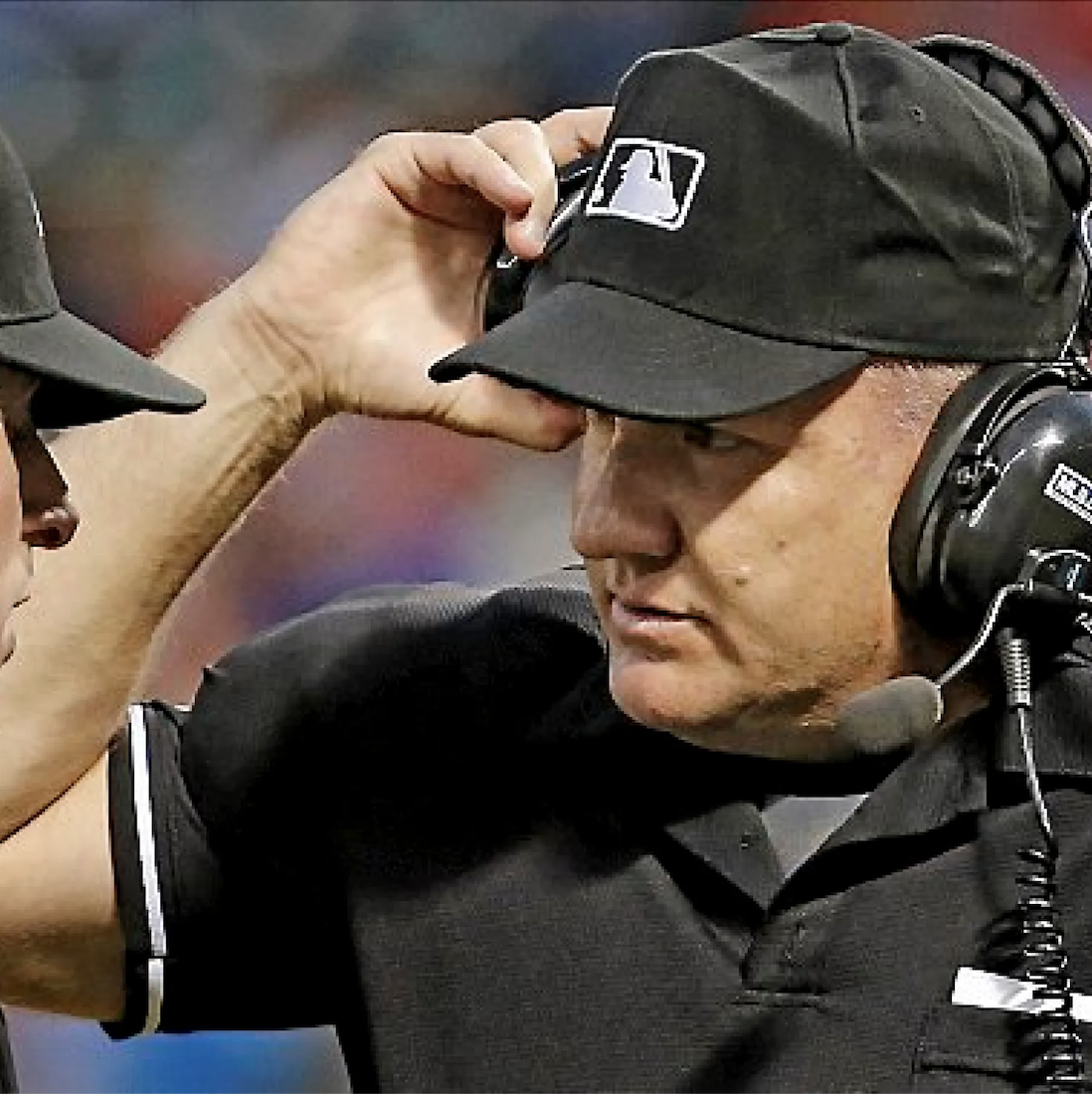
One of the things I've loved most about this project is asking baseball people not what happened, but what it felt like. Jeff Nelson spent nearly three decades in the middle of the biggest moments in the sport, yet his memories aren't about being seen—they're about getting the call right, staying in the moment, and quietly becoming part of baseball history. Listening to him describe the energy of a World Series crowd, the first game at Target Field, or the view from behind the plate in Game 7 reminds us that umpires experience our sacred ballparks differently. They aren't spectators. They're caretakers of the game.
We always hear players talk about "the call" to the big leagues. Do umpires celebrate it the same way? Do you remember where you were when you found out you were going to the majors?
Absolutely. I was in a Hampton Inn in West Des Moines, Iowa, with my parents, who had come down to watch me work a minor-league series. They hadn't been able to see many of my games because they lived in Minnesota. That's when I got the call to fill in at Dodger Stadium. It turned into this incredible full-circle moment because the only game I'd ever attended at Dodger Stadium was years earlier as a college student with my roommate and his dad. My major-league debut ended up being Dodgers versus Expos—the exact same matchup—and that same roommate was able to be there. It felt like everything had somehow come back around. I also remember walking into the clubhouse and realizing I wasn't in the minor leagues anymore. Suddenly, if you asked for an extra towel, someone said, "How many?" instead of finding reasons to say no. It sounds silly, but those little details made the big leagues feel different.
Players talk about wanting to homer in their first at-bat. What's it like for an umpire during those first few pitches of a major-league game? Were there nerves?
Oh, absolutely. Even though I was working third base, every pitch felt enormous. You're concentrating on every movement because you want everything to be perfect. You aren't thinking about the game itself so much as making sure your positioning is right, your mechanics are right, your judgment is right. You're trying to prove—to your crew, your supervisors, the players, everyone—that you belong there. The game goes by in a blur because every pitch feels like the biggest one you've ever seen.
Looking back, you've worked three World Series and two All-Star Games. What stands out the most?
Working home plate for Game 7 of the 2014 World Series. You're proud of surviving something like that more than anything else. There's an incredible amount of pressure because every pitch could decide a championship. During Salvador Perez's final at-bat, I wasn't thinking about history. I was hoping Buster Posey didn't accidentally block my view if Madison Bumgarner happened to throw a pitch at the knees. You're mentally preparing for the worst-case scenario on every pitch because one mistake lasts forever.
When Pablo Sandoval caught the final foul pop-up, everyone else could celebrate. I couldn't. My mind stayed in "plate job mode." It wasn't until about four o'clock the next morning that my body finally realized the World Series was actually over. Only then could I relax.
How different is Game 7 preparation compared to a regular-season game?
Everything changes. Different arrival times. Different meetings. Television crews. Microphones. Documentary filmmakers asking questions before the biggest game of your life. The trick is trying to make the strangest day imaginable feel as normal as possible because umpires are creatures of routine. I always told younger umpires not to invite family to the day they worked the plate. As much as you'd love having them there, you need your routine more than you need the celebration.
Your first World Series was the White Sox in 2005. What do you remember about that atmosphere?
My family was there, which made it special. For most umpires, your first World Series is also the first one you've ever attended. You've watched it your entire life, but suddenly you're standing on the field instead of sitting on the couch. There was an unbelievable buzz around that ballpark because White Sox fans had waited so long for that moment. You could feel the energy everywhere.
At the same time, you're reminding yourself that you still have a job to do. We always joked that being assigned the World Series would be perfect if you didn't actually have to umpire the games. You'd just accept the honor like an Academy Award and go home. Instead, now you have to perform under the brightest lights in baseball.
You also worked the All-Star Game in Minnesota, only eleven miles from where you grew up.
That was incredibly meaningful. Target Field is one of the nicest ballparks in baseball, and having my family nearby instead of traveling across the country made it even more special. I grew up going to Metropolitan Stadium, watched the Metrodome host an All-Star Game on television, and never imagined I'd eventually work one in my hometown.
The funny thing is that fans remember moments like Derek Jeter's final All-Star Game or Glen Perkins getting the save. As an umpire, you're so locked into your responsibilities that you don't always appreciate those storylines until someone points them out later. That's just the nature of the job.
Then came Opening Day at Target Field—the very first game.
That one was different. I normally wouldn't get excited about working a regular-season plate assignment, but this felt historic. Tim Tschida and I had actually walked the unfinished stadium months earlier with the Twins organization, helping review ground rules and thinking through how the ballpark would play. Watching it finally open, knowing we'd played a tiny part in preparing it, made the day incredibly rewarding.
As umpires, we look at ballparks differently than fans do. We're thinking about angles, walls, quirks and ground rules. But even through that lens, I knew Target Field was going to be a special place. It felt like a great day for Minnesota sports because everyone—from the organization to the fans—was excited about this new home. I'm really glad I was part of it.
Finally, what do you remember about the 2006 All-Star Game in Pittsburgh? A lot of people consider PNC Park the best ballpark in baseball.
The thing I remember most wasn't actually the game. It was watching people who had never been to Pittsburgh see that skyline for the first time. Everyone on my pass list was blown away by how beautifully the ballpark incorporates the city into the experience. They couldn't understand why more stadiums weren't designed that way.
The game itself was quick and crisp. It wasn't one of those marathon All-Star Games that drags on forever. People stayed engaged, the crew worked well together, and when it ended, it actually left you wishing there had been just a little more baseball. That's about as good as an All-Star Game can be.
NOTE: The above was edited for clarity and length.
You can read the full transcript here.