
Vince Cotroneo (Transcript)
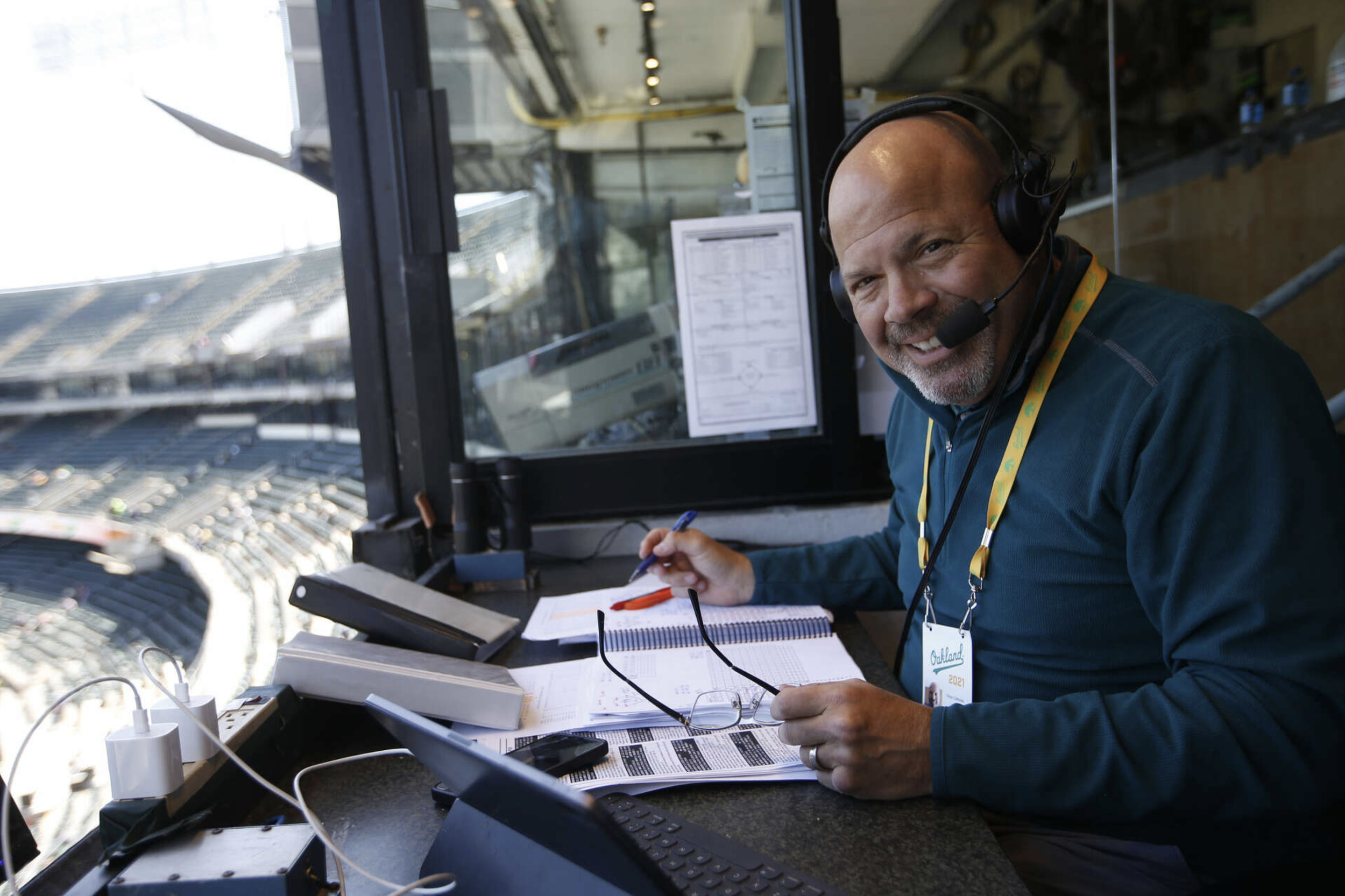
Robby Incmikoski: Vince Cotroneo, longtime voice of the Oakland A's. Vince, as we talked, you're now amidst the final series in Oakland. All of us are baseball fans, we love going there. The Coliseum is obviously a dump, but we love it, and it's a great place to watch baseball. What are the emotions like last night leading into today?
Vince Cotroneo: There was a time when it was apparent that this was gonna happen, that the Oakland Athletics were going to not exist under the same name, going back to last year. I think there was a lot of frustration and maybe even more pointed than that as last year went along. And then it came to this year, and it was a little more just kind of resignation that this is gonna happen.
But as an Oakland A's fan, you're saying, "I've got one or a handful of times left to go out and relive some of the memories I've had"—whether as a child, as a parent, or just as a fan in general—"to get one more opportunity to come to the Coliseum." Those that have not been to the Coliseum, it is as unique a setting as any in Major League Baseball.
A lot about territory. But the crowd is just unique, and this is not just me talking, this is Justin Verlander talking. This is the New York Yankees talking. These are teams and players that have come through there and recognize the uniqueness because of the passion of the fans with the horns and the drums and the flags and just the way that they have supported the club for decades. They've had a lot of success. The team hasn't quite taken it over the top, but they've been to the postseason 10 times since 2000. Not a lot of teams can say that. Now, they didn't advance as far as they would like, but there's a lot of good baseball that's been played there.
I think the fans that have come this past week and into the finale on Thursday, while they understand it's the end, they still want to be a part of it. They still want the team to know their passion. And I think the players are very honored and humbled that it's being directed toward them in a very positive light. Because if you wear that uniform—and it's unique, because typically when you're home, the home jerseys say the nickname of the team, in our case, the Athletics—but this final week against the Yankees and against the Rangers, they opted as a club collectively to wear the Kelly Green tops, which says "Oakland" across the front. That meant a lot to that clubhouse to show their support for the fans that have been there over the years.
So it's been challenging. It's been a lot of tears, a lot of emotion, not only in the clubhouse or on the field or in the press box, but just the people that have worked there for decades. I'm talking 30, 40 years that have been at that Coliseum—security, food service, marketing, whatever the case might be. There's just so many memories, and every memory is unique to each person.
For me, I spent the last several days as I talked to the security guys that I've seen for years, asking them, "How long have you been here? What's your first memory?" And they all have different memories because it has been such a special place. Thursday is gonna be hard for a lot of people that have to say goodbye to this franchise, which is a proud franchise. It's won four World Series. It's been to six World Series. There's a lot of success inside that Coliseum. And yes, it's unique, and yes, it's not showing its best side these days because the upkeep just has not been there. But it's still the Coliseum, and it's so special to a lot of people in the Bay Area.
Robby Incmikoski: What's it like for you, having been the voice of the franchise for two decades? When you look out at right field and I got to know those guys a little bit when I was with the Twins—not so much with the Pirates because we just haven't been there much—but when you look at those guys, you see them waving flags like they were last night, you just see the unwavering passion they have. What is that like for you guys in the booth?
Vince Cotroneo: It's an appreciation. These people, their lives revolve around A's baseball. It revolves around whenever the first pitch is. And a lot of them travel on the road as well, especially up and down California to a certain extent, even north to Seattle. We see them other places as well, but especially down south in Southern California.
The way that they look at this franchise is just hard to describe because it's such a special bond that they have. They have a bond with different broadcasters that have gone out there, with players like Jeff Greinke who sent pizzas to them, and he played for the Royals. There's this connection. Players still talk about it—Mike Trout talks about when he played in left field originally as a rookie and had the connection with the left field bleachers. They were making fun of him with the name "Trout" and having a fishing line, and he was enjoying it because he knows the uniqueness of playing baseball in the Coliseum.
These folks have become ardent supporters. Ken Korach has been with us for 29 years. He's our lead announcer, and I've worked with him for 19, but before that, there's been such a great history of broadcasters. Bill King, who won a Ford C. Frick Award, was in many respects the face of the franchise for years. And I got a chance to share the booth with him for a number of seasons. Monty Moore, who started back in the early days—just the legacy and the responsibility that we have had sitting in that booth, which honors Bill King because that's what it's named after, means a lot to somebody like me.
I didn't grow up in California, I didn't grow up in the East Bay, I worked for two other clubs before I got to Oakland, and yet they embraced me and allowed me to be a part of their traditions and allowed me to be included in some of their memories. And it's beyond humbling how that's played out.
Robby Incmikoski: Let's talk about Ray Fosse for a second. He was a wonderful man and a great baseball player. What was it like sharing a booth with Ray at the Coliseum? And how much did he love the A's and the Coliseum and the franchise?
Vince Cotroneo: That was it. Ray, every day, he found a way down on the field. If you were 0-for-4 last night, he would tell you it's the best 0-for-4 he's ever seen. He was always supportive of the players in good times and in bad times. He won two World Series, won Gold Gloves before he came to the A's with Cleveland, and was on a fast track to really be a superstar in the sport before the All-Star game incident with Pete Rose.
Oakland became his home, and sitting with him for radio broadcasts, especially all the playoffs that we had—because he was on the air in '06, and then '12, '13, '14, '18, '19, and '20—you can hear as we've played back a number of those great moments over the course of the past year: walk-offs by Coco Crisp or Stephen Vogt, or the inside-the-park home run for Mark Canha. In the voice of Ray sitting right next to you—he'd always pound his hands. They're like oven mitts, they're gigantic.
A guy that was recruited by Bear Bryant to play football tells you all you need to know about the physicality of Ray Fosse. But he was just a big bear. He really loved the organization. He gave his entire life to them. And those moments are the ones that I treasured the most, because it was Ken and Ray and myself, and it was just an opportunity to watch some high-level baseball at the most challenging time of the year and just see his joy.
Ray didn't just rest on the laurels of being Ray Fosse. I've been known for the kind of daily book work that I do to keep myself abreast of what's happening in baseball. My line of binders kind of pale in comparison to Ray Fosse's books that he kept over the years. He had the three-ring binders in a special little office back behind the press box of all these years of information. I think he appreciated that I did it to a certain extent and that we could collaborate on some things. But Ray loved the game, he loved the A's, and the love certainly was sent back to him tenfold with the fans' love of Ray Fosse.
Robby Incmikoski: I want to talk about some specifics, because you are the foremost expert. What is the difference in making a call when you see a foul ball in Oakland versus any other ballpark in Major League Baseball?
Vince Cotroneo: When you get a team coming to town and you get a player that's never played there—he could be a first-year rookie or he could be the status of a Juan Soto—and when they hit that first pop-up in foul territory, you've seen it hundreds of times, you know the result: that at-bat's going to be over. And yet the batter's standing in the batter's box going, "In my home ballpark, that's 12 rows back. That gives me a chance to get another swing and maybe win the battle." And it just doesn't happen.
There have been great diving plays by Eric Chavez, Josh Donaldson, Matt Chapman diving into that tarp next to the wall behind third base, great running catches toward the bullpen on both sides—first base and third base.
It really explains why when you look back on the A's franchise, how key third base was: Sal Bando, Carney Lansford, Eric Chavez, Josh Donaldson, Matt Chapman. First base with all those great players and culminating with Matt Olson and what he did. You needed those players that recognized how they could play the position differently than they would play anyplace else.
It's always an adventure because something is going to happen that just doesn't happen anyplace else. Not only that, but day games at the Coliseum make Gold Glovers fall to their knees and not make catches. They just lose the ball. It's just something about the high sky in Oakland that has taken down Gold Glove players—they simply lose the baseball.
Obviously, in 2012, that was the biggest play for the A's in Game 162, when Josh Hamilton dropped the ball, which led them to finally winning the West on the very last day of the season, halfway through the very last game. So the Coliseum takes and it gives away. It's tough to hit home runs there, especially at night in April and May with the marine layer. Foul territory is unique only to Oakland, and it's a special place. Watching those plays unfold is just part of the charm of the Coliseum.
Robby Incmikoski: I have a camera and I take a bunch of pictures that are gonna help illustrate this story. I want you to describe physically what the walk is like from the time you exit your car and get into the Coliseum and take that elevator up. How do you describe just the uniqueness of that elevator and that press box at the Coliseum?
Vince Cotroneo: We'll take it both ways. You park in what's known as the F lot. That's where the players and broadcasters park, and you walk by the TV trucks. You walk down a corridor, and to your right was a door that led downstairs toward a very antiquated, small Oakland Athletics clubhouse. Especially in September, when you could call up five, six, seven, eight players on your 40-man roster, space was a priority. Steve Vucinich, the longtime equipment manager, had lockers in the middle of that room because there was no place to put them. The Raiders were still there and occupied what is now the Raiders clubhouse. So when they left, the A's got the space that most teams are accustomed to, especially on the home side.
But you walk down that corridor and you walk to the elevator, you walk up those three or four steps, and you press the button. First, you say, "I hope the elevator is working today," because there have been many times when that was not the case and you had to take the long trip around. You'd go upstairs, walk into the stadium, and go up another elevator back behind the press box.
For us, when you come off the elevator, we're right on home plate. So we're right on the 50-yard line too for the Raider games. When you walk off the elevator, you walk right into our booth, and it's perfect because of placement, our size, and what we're allowed to do.
But when you're ready to go downstairs, you get back in the elevator, you cross your fingers, and you take it down to the lowest level. You step out, you go to your left, and as you're making your way that way, you see the umpires' small room on the right-hand side. Then you make a left, you go past a very small visitors clubhouse, and down those steps which are always wet because they're always washing them off and they never dry.
Eventually over time, they tried to dress up that hallway by putting up fake brick and some great pictures of great days from the past—Dave Stewart, Jason Giambi, Jose Canseco, Rickey Henderson, whatever the case might be. So you saw that, at least, because that's where the folks that buy the most expensive tickets, the diamond level seats, have to walk down those steps. They put up this little plastic band that divides that hallway in half, where you have to walk on the left-hand side and the visiting players coming from their first base dugout are walking up and down on the right-hand side.
It's different, but you walk out and you make a left and you walk toward the A's third base dugout. As you saw in the movie Moneyball, it's just as it is. When you walk out there, you have this little path for the fans, unlike any other place, where fans are leaning over the railing as you're walking toward the dugout pregame—certainly just before first pitch—asking for autographs, and players and coaches and managers obliging over the years.
So that's the walk. It's not quite like walking down the steps at Fenway and walking through that corridor, because you think about Babe Ruth or Tris Speaker and Jimmie Foxx—take your pick. There are certainly greats that have walked down these steps, and the A's have had Hall of Famers too. So that does come to mind, but not quite as prevalent as you think about at Fenway. But again, for Oakland, it's special to them. It's a unique setup, and they've kind of made it work for years.
Robby Incmikoski: That's amazing. We just spoke with Ken Korach an hour ago before you, and we were talking about how Aaron Judge is walking down with a fan. You've got to walk past the nachos to get to the dugout, and there's nothing like it.
Vince Cotroneo: For the players, they can't escape. The visiting players have to go through a corridor on their side as well, and the diamond level seat guys are leaning over the railing just on every player.
Robby Incmikoski: Are you taking a piece of the Coliseum with you? I mean, I don't know if you're allowed to even say that—obviously, this is public. But do you want something physical? I got a buddy of mine who runs Ice Barrel, so he gave me a piece of the bench that's certified. They cut up past benches. So I have a small piece of the bench that I think is cool, and I bought a pennant that said "Rickey Henderson Field, Oakland Athletics." I love doing games there. It's just a cool place. Are you into that kind of stuff? Will you take anything with you?
Vince Cotroneo: I've never been much of a collector. I might grab a little bit of dirt tomorrow from Clay Wood, our tremendous head groundskeeper over the years. If I've gotten items, I've gotten them for other people—for fans or for people that really are supportive of the ball club. It's never been for me. I've got a zillion pictures with Rickey, with Eckersley, with Reggie. I've got all the shows that I've done over the years on the history of the club. Those are my memories, and it's easier for me that way.
I'm thankful for the 19 years which were incredibly special times. As I said publicly a few times, we raised our family here. I walked my daughter down the aisle. She's earned her husband now, giving us our first grandson. My son works in baseball full-time. And our youngest daughter, when she was 13 when we traded Yoenis Céspedes back in 2014, she was red hot, and she's still mad to this day about that trade. But that's the passion that my family has, and that's the passion that you multiply time and time again for everybody that's been in that Coliseum as a fan. That's waved the flag, blown the vuvuzelas, banged the drums, sat there in their jersey—sometimes with a name on the back and sometimes without because they were so fearful that player wouldn't be around much longer, as that has been the history of this franchise. But they still came out in numbers, and it still means a lot to them, whoever their favorite player is.
Tonight on our pregame show, it's totally subjective. It's just simply my opinion, but I'm putting together my Oakland A's team of the 57 years. I'm putting together an entire roster. It's subjective because I'll pick a position or a player, and somebody will say, "No, I want that guy or I want this guy," and that's the beauty of baseball. It is a talking sport. It's a sport you follow religiously day in and day out. It takes you from spring to summer to fall. For those of us that have worked in it for a lot of years, it makes it the greatest game, and I'm just beyond blessed that I've been a part of it as long as I have.
Robby Incmikoski: How would you describe the vibe? You look at these fans. I know they've had their attendance issues—we get all that, and that's not down to the fans. I know it's been a disaster from the ownership and all that. But when you talk about the pure baseball fans—we're celebrating baseball in Oakland in this book, we're talking about how great the game is to these fans. What kind of a connection does that team have with the fan base in your two decades around? How would you describe that?
Vince Cotroneo: I would look at it two different ways. One, when I was a visiting broadcaster—I worked six years with the Texas Rangers, so I came to Oakland quite a bit, and we were involved down to the wire in pennant races that they won and we won along the way. I always marveled when I walked into the Oakland clubhouse. It was the smaller clubhouse back then. Just that vibe seeing Giambi and Chavez and Tejada and just seeing the way that they dealt with their day, how they handled getting out to the field—Carlos Peña, it just goes on and on—Hudson, Mulder, and Zito, all those guys. It was just a unique family that I saw from afar.
Then when I got a chance to be here for 19 years, I certainly got an even higher appreciation of what makes that clubhouse work. This is the little engine that could because it's never been the team, at least recently, that has spent that kind of money. Although back in the '80s, they were the rock stars. They were McGwire and Canseco and Rickey and Hendu and Stu and Bobby Welch and Eck. They were the team that when they showed up on the road, they had to go through the service elevators because there were too many people blocking their opportunity to get into the hotel—which you see all the time now with teams like the Yankees. But they were the Yankees, and they led the league in attendance, and at one time they led the league in payroll. That's how times have changed in Oakland.
But it just works with Oakland and San Francisco—they're just two different groups of people. Oakland is more blue-collar, more hard-working. I'm not saying they're not hard-working in San Francisco, but it's just a different feel for the fan that comes to an Oakland A's game.
A lot of people have grown up there and spent their whole lives there. I've got a friend that was in charge of Chevron for decades. She's retiring, but she grew up in Oakland, and she wears her Oakland colors proudly wherever she goes. Jonas Rivera, who is one of the top people at Pixar, which is based in Emeryville—he grew up in Castro Valley. He's been in the East Bay his entire life. He went to games with his dad. Rickey Henderson was his favorite player. He brings his son, William, to the games now.
Those generations—it's not just the people that feel like "my day has to revolve around the green and gold, and I'm gonna do everything I can to get to the game. If I can't, I'm gonna watch or listen to the games and pay attention." But it's pillars of the community that grew up there as well that have that same kind of kinship with the Oakland franchise because they grew up there the same way and enjoyed their memories—whether it's Mitchell Page or you go all the way back to Mike Epstein, or you go to Sal Bando, or you go to the '80s, and there are some names that maybe don't necessarily jump off the page for some, but they do for the fan who says, "This is my favorite player," and it's because of this—either "I went to the game and he did that," or "he signed a ball for me," or whatever the case might be. That connection that every fan has starts somewhere in a unique place.
The great thing about what I've noticed with baseball memories is they stay with you forever. I'm 14 years old, and I'm going to see the New York Mets play at Shea Stadium against the Kansas City Royals in 1974. And I remember Roy White had a big game, and Bobby Murcer hit a home run, and my favorite player, Thurman Munson, was in the game. Multiply that for a franchise, and it makes it more difficult because the franchise is leaving, and I think they want to hold on to those memories as long as they can.
More importantly, I think they want to show—because there's a lot of attention right now on Oakland this week—I think they want to show the rest of the country what it meant to be an Oakland Athletics fan, and they're getting a chance to do that. I'm really happy that that's happening for them.
Robby Incmikoski: What is your booth up there like to call games? I know it's old, but what's it like calling games in a non-modern ballpark?
Vince Cotroneo: Again, other than a possum walking over my leg a couple of years ago, it's a perfect booth. Like I told you, it's enough space. It's right on home plate. Ken and I, and Ray, and the countless guys that I've worked with when they filled in on the air—it's a wonderful place to work. It's a booth that has history.
Sure, everybody wants new, nicer things, and the A's are not any different than that. It's unfortunate that for whatever reason, they were unable to make this happen in the East Bay. But for what we have, when I walk into the space that I work in, it has everything that I need from a broadcasting perspective. I have space on the counter. I've got a counter behind me with a little refrigerator. I've got our great engineer, Michael Baird, up above. We have our intern that sits above as well. Ken's to my left, and when Ray was there, Ray was in the middle. It was the perfect setting, and it has been until Thursday and will be a great place to sit in and do a baseball game.
Robby Incmikoski: Man, that's incredible. What about the vibe around the broadcasters, the team? I know the players don't think about that, but how have you been able to endure this last year without outright fighting all the distractions that all of you had to deal with? How have you managed it?
Vince Cotroneo: Last year was the tough year for a number of reasons. It looked like they were moving away from Oakland, and the team only won 50 games. So from our perspective, sitting in the booth, Ken and I just looked at each other and trusted each other, and our mantra was, "Let's see what today brings us," because that's the beauty of the game. You just don't know what's gonna happen at a baseball game. Even if you only win 50 games, there will always be stories to tell about the player or about players or about the game on a given day.
And there are people who, win, lose, or draw, may not be at the Coliseum, but when 6:40 hits, their day starts because they know it's time for baseball. They're gonna turn on the radio, they're gonna turn on the television. That's what finishes their day. That's what puts a smile on their face, maybe in a circumstance where they don't have a lot of positive things in their life. But this is their team, and we get a chance to bring that to them. So it's been humbling to be able to deliver that message for sure.
Robby Incmikoski: Vince, one final thing before I let you go. I saw Rickey was there. I saw Carney Lansford, I think, was there recently. A lot of the greats in that franchise have come back. How great a celebration, despite the sadness—we know that—but how great a celebration of baseball is it at the Coliseum this week?
Vince Cotroneo: We're gonna find out tomorrow. It'll be exciting. Rickey, Dave Stewart's gonna be there—two pillars of the franchise, two pillars that grew up in Oakland. Again, that's the connection. The other thing about Oakland is the great sports legacy in general: Willie Stargell, Frank Robinson, Bill Russell, Rickey Henderson. There's a litany of players in a variety of sports that grew up in Oakland and became stars after leaving the East Bay. That's a rich history, even going back to the Little League days. We're talking about the kids that were all playing back in the early '60s and '70s, Billy Martin coming from Berkeley, things of that nature. You go on and on about what that means.
I think the A's fans are going to show their pride. I think they're gonna stay to the very end, because that's something they've always been very good at. And again, for us, when we say goodbye, I know it's gonna be emotional because it's already emotional now. But they've allowed us to come into their homes and help them root for their favorite team, and that's not taken lightly, never has been.
And while I'm not getting an opportunity to move forward with this club—that happens in a very subjective business, we both are intimately aware of that—I get to leave after 19 really good years. If they're leaving and I'm leaving with them too, it's not a bad way to say goodbye.
Robby Incmikoski: Vince, this is gonna go in this book forever, and I don't want to get too emotional, but I'm not trying to get too emotional. But how you're gonna go down in history as one of the faces and voices of that franchise. How cool is that for you?
Vince Cotroneo: I appreciate that. I was out of baseball for two years before I got back in with Oakland, and it was part of the relationships we all developed over time that we don't necessarily know if we're gonna rely on. I started in 1981 with Tom Kelly in the Orlando Twins. I was still in college, and I knew Ken when he was at Las Vegas in the PCL and I was in Tucson in the PCL. Then when I went on to Houston and Texas, and he did the White Sox and then he came to Oakland. So there was a familiarity there.
But the circumstance that allowed me to come back into the game was really tough, because Bill King, for people that don't know, was that icon—not just because of his work with the Athletics, all the great years with the Raiders with John Madden. He called the first Warriors championship in the mid-'70s.
So Bill had been there forever, and in his 25 years with the A's—through Rickey breaking the record and Dave Stewart's no-hitter and Hudson, Mulder, Zito on this run of postseasons—I knew Bill because of our fraternity. I was on the other side of the glass with the Rangers, and we would engage in conversation. And then Bill passes away unexpectedly, and it created an opening.
So we end the All-Star break in Oakland. I gave up a home run to Mark McGwire on a Sunday, and then the All-Star game was two days later, Tuesday. So I stayed in Oakland. Everybody else left, the Brewers. And I remember I'm nervous. What do you do? I'm at the hotel, got on the bus, and I'm like, I don't know anybody. And here I am, this guy playing with Milwaukee, I have a year and a half in the big leagues, and I'm on the bus with Dave Winfield and Don Mattingly. And I'm just like, I feel so out of place.
My very first broadcast in spring training of '06, the first words out of my mouth were telling the fans, "I'm not Bill King. I knew Bill King. I know what he meant to you, and you did not get a chance to say goodbye to him. And for that, I am sorry. But I've been asked to do a job here, and I am hopeful that over time, you give me an opportunity to do it to the best of my ability—that you like my voice or you like my smile or you like a certain call, or you like the interviews." And that kind of hopefully multiplies over time, and you get a chance to get some footing and work for 19 years.
For that, I'm very appreciative, even in these most difficult of circumstances. Like I said, I'm not from Oakland, but they made me Oakland. And that's the highest compliment that I can get. So I'm thankful.
Robby Incmikoski: You're in Oakland legend, no matter how you slice it, brother. I'm so sorry this has happened. I don't mean to get you emotional, but I was kind of hoping to talk to you during this to kind of capture the emotion of it all.
Vince Cotroneo: It's all good. Thank you for asking.
Robby Incmikoski: It's gonna come out really good. I'm really proud to have you in this, Vince. I really appreciate this, brother. So I hope you can enjoy it. I texted Eric Chavez—he said he's having a little bit of a rough go last night and today. He's sending me another—Marcus Semien's gonna get something. I don't know if he's gonna get a base or something, but he's gonna take something from there, being a Bay Area kid who grew up rooting for the A's or Giants.
Vince Cotroneo: Tomorrow they're gonna change the bases out every inning.
Robby Incmikoski: Every inning? There's gonna be 27 bases. That's cool.
Vince Cotroneo: Yeah, so Eric will get a bunch of them for that specific purpose.
Robby Incmikoski: That's cool. Maybe I'm gonna give it a couple weeks, Vince, and maybe we can revisit and just see what those last two days were like, if that's cool with you. We'll just redo this in your downtime, because I told Kyle, I'm hitting up all the baseball talent. We all know what these last two, three weeks of a season are. So I'm trying to exercise as much as I can while people are still in the routine. So I'm trying to get fans and coaches and stuff while they're still in the routine. Why wait? I'll hit up my baseball brothers in mid-October once they've had a chance to decompress.
Vince Cotroneo: Reach out anytime. You know where to find me.
Robby Incmikoski: I got you, Vince. Obviously, holler if you need anything. But you're the best, man. Thank you for doing this, Vince. Thank you. Enjoy these next few days as best you can, man. Just know I'm thinking of you. I'm watching every pitch, man. I'm watching from my couch.
Vince Cotroneo: All the best to you too. Hope you land someplace that you like.
Robby Incmikoski: I will, Vince. All good, brother. I'll see you, man. Thanks. Bye.
Vince Cotroneo: Take care. So long.